CT River Trophy Stretch
Fishable
Flow324 CFS
Trendstable
Clarityclear
Temp63°F
Foam Park Hopper #10 (tan)NBK Caddis Dry #16 (olive)Holy Grail #16 (olive)T.H. Soft Hackle Caddis Pupa #16 (olive)
| What | When | Key Numbers |
|---|---|---|
| Connecticut River Trophy Stretch | Jan 1 - Oct 15 (best: June, Sept-Oct) | Fly-fishing only; 2 trout daily, 12" min |
| Androscoggin River | Year-round (best: May-June, Sept-Oct) | C&R section: barbless, artificial only |
| Saco River | Jan 1 - Oct 15 (best: May-June, Sept) | FFO section: 2 trout daily; below 1,000 CFS for wading |
| White Mountain streams | Late April - Oct 15 (best: June-Aug) | Wild brook trout; 2-3 weight rods |
| Guided trips | Book spring trips by February | $200-$550/day depending on trip type |
| Fly shop | Lopstick Outfitters (Pittsburg) | (603) 538-6010 |
New Hampshire packs a surprising amount of quality fly fishing into the sixth-smallest state in the country. The headwaters of the Connecticut River -- New England's longest waterway -- originate at the Canadian border in Pittsburg, where a bottom-release dam creates a cold-water tailwater fishery capable of producing brown trout over 15 pounds. The Androscoggin River's remarkable environmental recovery from polluted mill river to one of New England's finest trout streams is a conservation success story. And the White Mountain National Forest harbors over 700 miles of fish-bearing streams where wild native brook trout still thrive in cold, canopied headwaters.
The state offers four primary trout species on the fly rod: brook trout (the official state fish), brown trout, rainbow trout, and landlocked Atlantic salmon. Add warmwater opportunities for smallmouth bass on the Connecticut and Merrimack rivers, and 18 miles of coastline for striped bass, and a visiting angler can experience remarkable diversity within a compact geography.
NH Fish and Game stocks roughly 400,000-500,000 trout annually across the state, and nearly 50 backcountry ponds receive helicopter-delivered brook trout fingerlings each year -- a unique wilderness program that produces trophy brookies exceeding 17 inches in remote mountain settings.
Drive Times from North Conway (Central Base):
| Destination | Distance | Time |
|---|---|---|
| Saco River (FFO section) | 2 miles | 5 min |
| Ellis River (Jackson) | 10 miles | 15 min |
| Kancamagus Highway / Swift River | 3 miles | 10 min |
| Androscoggin River (Gorham) | 25 miles | 30 min |
| Connecticut River Trophy Stretch (Pittsburg) | 130 miles | 2 hr 30 min |
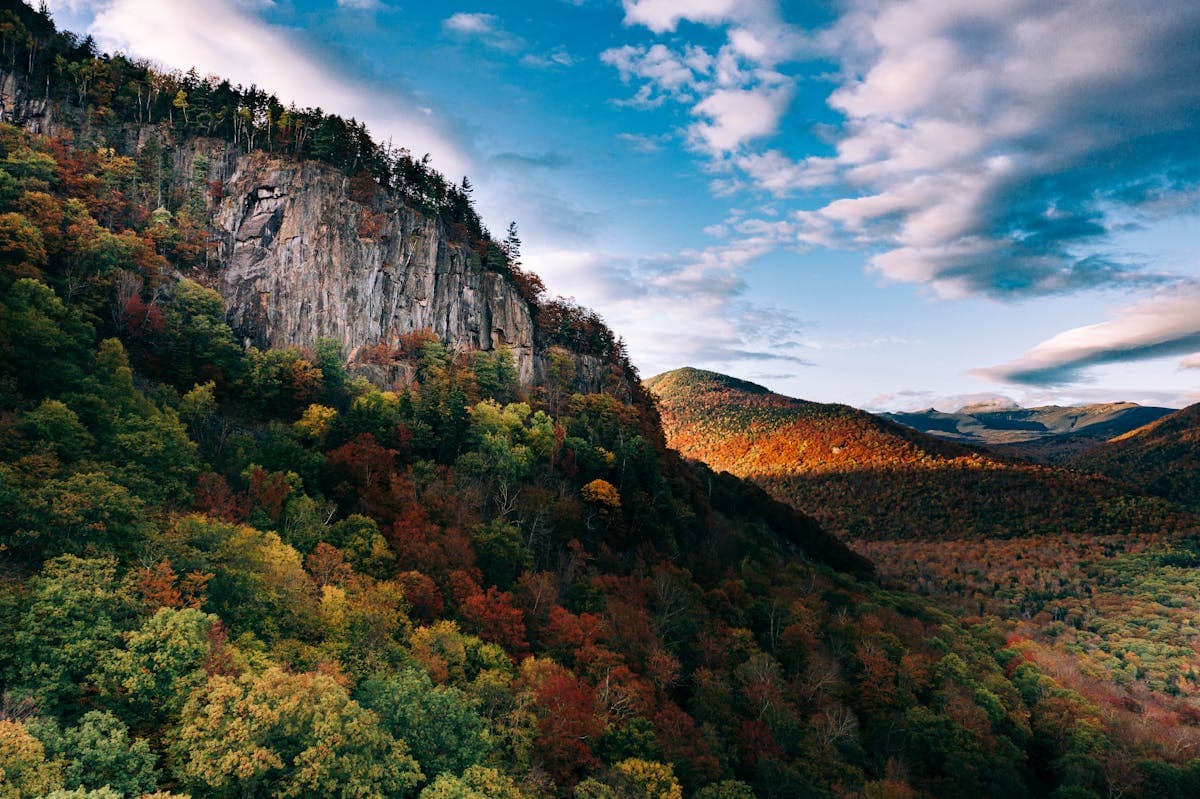
Fall foliage in New Hampshire's White Mountains -- September and October bring prime fishing conditions alongside peak color
New Hampshire's fishing calendar revolves around snowmelt from the White Mountains and the state's general trout season, which runs January 1 through October 15 on rivers and streams. Most waters close from October 16 through December 31 unless they carry special regulations.
Spring (March-May): Snowmelt drives high water on freestone rivers. The Connecticut River Trophy Stretch opens January 1, and smelt runs in April trigger aggressive feeding from salmon and trout. Hendrickson and grannom caddis hatches begin in late April. Drift boat trips on the Androscoggin and Connecticut start as water levels stabilize in May.
Summer (June-August): June brings the best hatches -- gray drakes on the Saco, alder flies on the upper Androscoggin, and the Hex hatch from late June into July. The Connecticut River Trophy Stretch fishes exceptionally well all summer because the bottom-release dam keeps water temperatures below 55 degrees F. Most other rivers warm significantly by mid-July; focus on tailwater sections, small mountain streams, and early morning or evening windows. The Androscoggin reaches lethal temperatures for trout in July and August due to top-release dams -- guides stop running most trips.
Fall (September-October): Prime time. Water cools, fish feed aggressively ahead of winter and spawning season. The Androscoggin fishes at its best in September and October. Brown trout concentrate in tributaries for their November spawn, creating opportunities for large-fish streamer fishing. The trout season closes October 15 on general waters.
Winter (November-February): Limited opportunities. The Connecticut River Trophy Stretch and the Androscoggin C&R section (Berlin to Shelburne) remain open year-round. Streamer fishing with sinking lines in the warmest hours of the day. Ice fishing is popular on lakes and ponds.
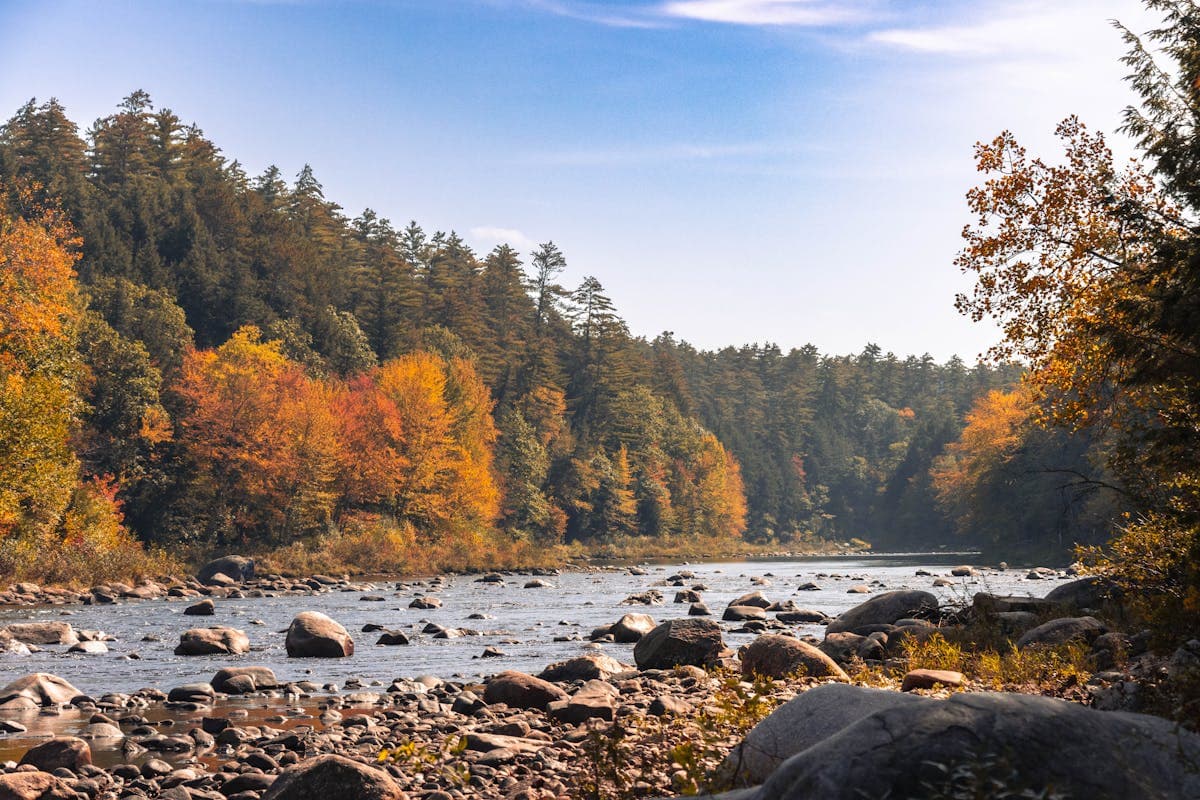
The Pemigewasset River near Campton, New Hampshire -- boulder-strewn pocket water surrounded by fall color
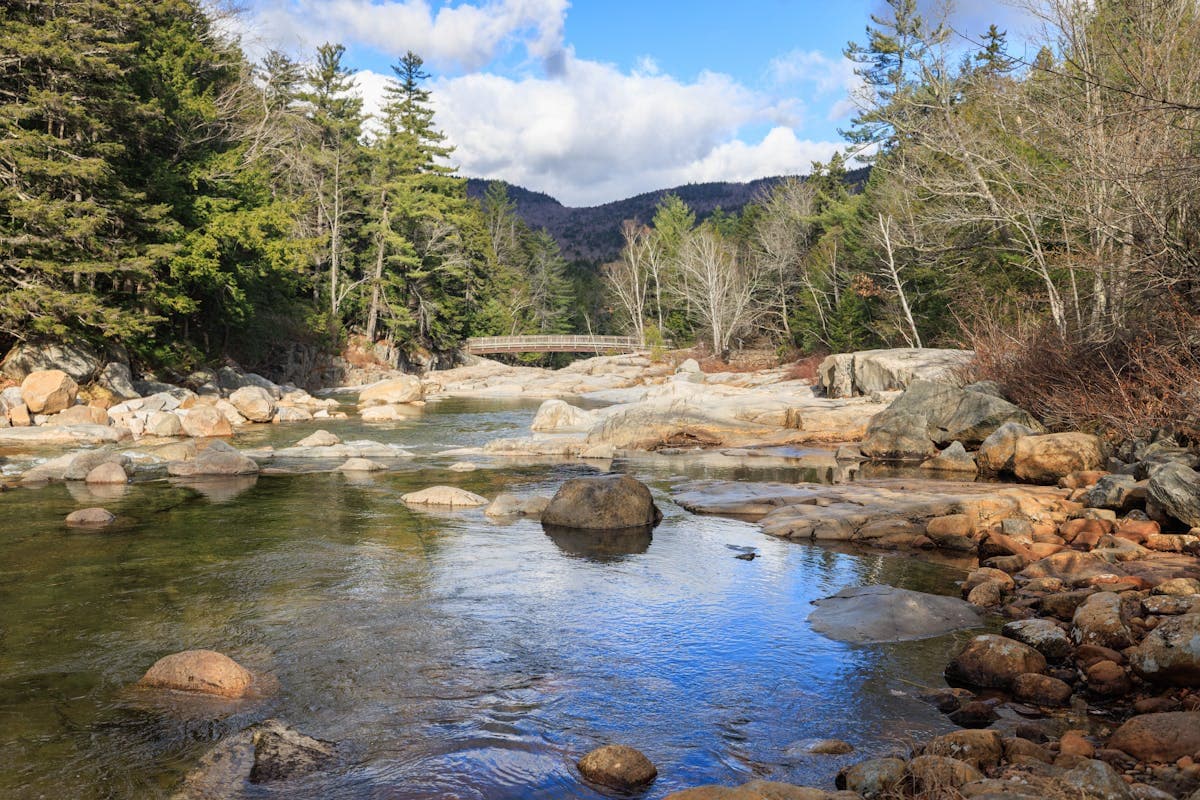
The crown jewel of New Hampshire fly fishing. This 2.5-mile stretch of pocket water, riffles, and pools between First Connecticut Lake and Lake Francis holds brook, brown, and rainbow trout along with landlocked salmon. The bottom-release dam delivers water that rarely exceeds 55 degrees F, making this a genuine year-round fishery.
The Trophy Stretch is fly-fishing-only with a two-fish daily aggregate limit (12-inch minimum for trout, 15-inch for salmon). The riverbed is rocky with boulders and gravel, and wading is the primary access method. A didymo cleaning station sits at the main access point -- use it.
Access and parking: The primary access is off Route 3 about one mile south of Lopstick Lodge. A gravel road leads to a small parking area near the dam at First Connecticut Lake. From there, a railroad-grade dirt road parallels the river downstream for the full 2.5 miles to Lake Francis, with footpaths branching off to the water at several points. Most anglers park at the top and fish downstream, working pool to pool. On busy weekends (especially Memorial Day through July 4th), arrive before 7am or you may find the upper pools claimed.
Key spots from upstream to downstream:
What to bring:
Base yourself at Lopstick Lodge (Orvis Endorsed, Outfitter of the Year 2013) or Tall Timber Lodge for on-site fly shops, guide services, and cabins overlooking the Connecticut Lakes. Track flows on RiverReports.
The Androscoggin flows 178 miles from Errol through Berlin and Gorham before crossing into Maine. After a paper mill closed in 2006, this river transformed from a heavily polluted waterway into one of the finest trout rivers in New England.
Two distinct sections matter for fly fishers:
Upper Androscoggin (Errol): Tailwater below Errol Dam. Fly-fishing-only from the dam to Bragg Bay markers, with a two-fish limit (12-inch minimum). Nutrient-rich water from Lake Umbagog fuels exceptional insect hatches and fast-growing trout. Accessible and beginner-friendly.
Lower Androscoggin (Berlin to Maine border): The largest stretch of catch-and-release water in New England. Single barbless hooks and artificial flies only, no closed season. Wild, naturally reproducing populations of rainbow trout (8-14 inch average), brown trout (some exceeding 20 inches), brook trout, and landlocked salmon. The "Andro Grand Slam" -- catching all four species plus smallmouth bass and fallfish in one day -- is a realistic goal. The lower river is an easy day trip from North Conway (30 minutes to Gorham), and Road in Groveton follows stretches of the stream for wade access. But much of this big, broad water is best reached by drift boat.
Floating is the best way to cover this big, broad river. Hill Country Guides offers drift boat trips starting at $425 for a half day.
Critical summer warning: Top-release dams from Lake Umbagog warm this river to dangerous temperatures for trout in July and August. Most guides stop running trips. Fish the Androscoggin in May-June or September-October.
Fly patterns by season:
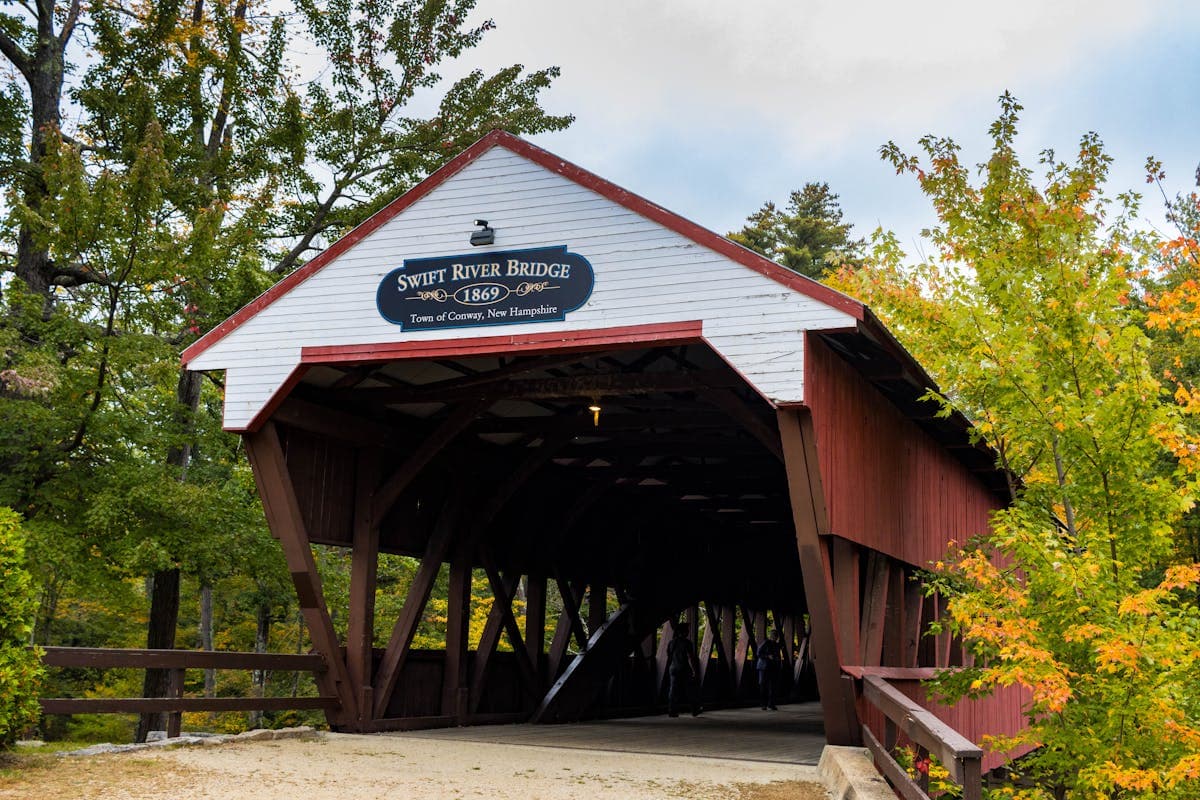
The Swift River Covered Bridge in Conway -- covered bridges mark several access points along the Saco and its tributaries
The Saco originates at Saco Lake in Crawford Notch and flows through the Mount Washington Valley past Bartlett, North Conway, and Conway. Crystal-clear water over a light gravel and sand substrate makes this a premier sight-fishing river.
The fly-fishing-only section from Lucy Brook to Artist Falls Brook in Conway has a two-fish daily limit and holds both stocked and wild trout. Large brown trout exceeding 20 inches are a realistic possibility, particularly in fall when spawning fish become aggressive. Access the FFO section from the Humphrey's Ledge area or the covered bridge off East Side Road in Conway. On weekends, anglers concentrate in the FFO stretch -- weekday mornings are noticeably less crowded.
Flow considerations: The Saco is a freestone river with flows ranging from 300 to 3,000+ CFS after storms. Below 1,000 CFS, the river wades comfortably. Above 1,000 CFS, consider a drift boat or raft for access to big-water browns. Track conditions on RiverReports before making the drive.
Hatches: Hendrickson mayflies (early season), gray drake spinner falls (June), caddis throughout, terrestrials (grasshoppers and beetles) in summer, Blue-winged Olives in fall.
Summer reality check: Heavy tuber and canoe traffic ("the rubber hatch") on weekends from Conway to First Bridge. Fish early mornings or target the fly-fishing-only section where traffic is lighter.
White Mountain Anglers and The Swift River Ghillie guide wade and float trips on the Saco.
A classic mountain stream flowing from Tuckerman Ravine's snowmelt on Mount Washington through Jackson. The fly-fishing-only section from the covered bridge to the Iron Bridge in Glen holds wild brook trout and larger rainbow trout.
What makes the Ellis special: it fishes well through hot summer days when other rivers warm up. Snowmelt from the Presidential Range and dense forest canopy keep water temperatures manageable. Fish shift feeding habits regularly here, making it an excellent learning stream where you'll cycle through techniques on a single outing.
Hill Country Guides operates from the Riverwood Inn at the confluence of the Ellis and Wildcat rivers -- a natural base for a White Mountains fishing trip.
The Pemi originates in Franconia Notch State Park and flows 70 miles south. Above Lincoln, the White Mountain National Forest stretches offer wild brook trout in spectacular scenery. The 8-mile Ayers Island section near Plymouth is popular for Class II paddling with a famous play spot called Rodeo Hole.
For fly fishing, the upper reaches above Lincoln are the main draw -- small, cold, and full of wild brookies that respond well to dry flies and "buggy" nymphs. A 3-4 weight rod is optimal. Profile Lake at the river's source is fly-fishing-only.
This 27-mile Connecticut River tributary begins at the outlet of Lake Sunapee and flows west through Newport. The fly-fishing-only section in Newport (Route 11/103 bridge to Oak Street bridge) is open January 1 through November 30 -- one of the longest seasons in the state. Stocked with rainbow, brown, and brook trout, the Sugar River produces Blue-winged Olives, Slate Drakes, Little Brown Stoneflies, and caddis from spring through fall. Access the river via the rails-to-trails recreation path (note: shared with dirt bikes and ATVs, which can be noisy on weekends).
The fly-fishing-only section from the Route 4 bridge near Enfield to the Packard Hill covered bridge in Lebanon is a sleeper. Two-trout daily limit, open January 1 through October 15. The river is accessible via a rails-to-trails path and hosts an annual whitewater slalom event on the Class II-III section below Mascoma Lake. Not a destination fishery, but a solid day trip if you're in the Upper Valley or Dartmouth area.
The Contoocook flows 71 miles from Jaffrey to its confluence with the Merrimack near Concord. The Henniker section (2,500 feet above the mill dam, upstream one mile) has special regulations: single-hook artificial lures only, two-trout limit with a 12-inch minimum, open January 1 through November 30. The river also harbors some of New England's best whitewater -- the Hillsborough to West Henniker stretch drops 50 feet per mile through Class III-IV rapids including the well-known Freight Train. Not a typical fly fishing destination, but the Henniker fly section produces stocked and holdover trout in a pleasant college-town setting.
A fly-fishing-only stretch from Troy to Swanzey in the southwestern corner of the state. Two-trout daily limit, 12-inch minimum. Quiet water in the Monadnock Region that doesn't draw the crowds of the White Mountain rivers. The Surry Mountain Dam release (typically late April, 275 CFS) creates a brief whitewater paddling window.
Four rivers near the coast -- the Cocheco, Exeter, Isinglass, and Lamprey -- carry year-round seasons with special off-season rules. From October 16 through late April, these waters are catch-and-release only with barbless artificials. From late April through October 15, standard five-fish limits apply. These are stocked put-and-take fisheries, but the extended seasons make them a useful option for southern NH anglers who don't want to drive to Pittsburg for winter fishing.
When trout rivers get too warm in mid-summer, or after the October 15 trout season closure, warmwater species fill the gap.
Smallmouth bass fishing is strong on the Connecticut River (particularly the sections from Haverhill south) and the Merrimack River. Bass are open year-round, with mandatory catch-and-release from May 15 to June 15 during spawning. After June 15, topwater poppers and Clouser Minnows on a 6-weight rod provide fast action. The Connecticut's wide, rocky runs fish like a Western freestone river for 3-5 pound smallmouth.
Northern pike inhabit the Connecticut River and select lakes, with a one-fish daily limit and 28-inch minimum -- genuinely trophy-only regulations. Pike are open January 1 through October 15 on rivers. Fly fishers use 8-weight rods with wire tippet and big articulated streamers. Lopstick Outfitters offers dedicated pike trips ($450/day) in the Pittsburg area.
A consolidated reference for the major insects across NH waters. Timing varies by elevation and water temperature -- mountain streams run about two weeks behind valley rivers.
| Month | Insect | Size | Recommended Flies | Best Waters |
|---|---|---|---|---|
| Late April | Hendrickson mayfly | #12-14 | Hendrickson Dry, Pheasant Tail Nymph | Saco, Sugar, Ellis |
| Late April | Grannom caddis ("Mother's Day caddis") | #14-16 | Elk Hair Caddis, X-Caddis | Saco, Connecticut |
| May-June | Blue-winged Olive | #16-22 | Parachute Adams, BWO Emerger, Comparadun | All rivers |
| May-June | Sulphur mayfly | #14-18 | Sulphur Dun, Light Cahill | Connecticut Trophy Stretch |
| June | Gray drake | #10-12 | Gray Drake Spinner, Comparadun | Saco |
| Late June | Alder fly / "zebra caddis" | #12-14 | Alderfly imitation, dark caddis | Upper Androscoggin (above Berlin) |
| Late June-July | Hex (Hexagenia) | #6-8 | Hex Dry, Hex Nymph | Androscoggin |
| July-Sept | Terrestrials | #10-16 | Foam Beetle, Dave's Hopper, Ant patterns | Saco, Ellis, small streams |
| Sept-Oct | Blue-winged Olive (fall) | #18-22 | Small BWO, RS2, Sparkle Dun | Connecticut, Androscoggin |
| Year-round | Midges | #20-24 | Griffith's Gnat, Zebra Midge, WD-40 | All rivers |
| Year-round | Caddis (various) | #14-20 | Elk Hair Caddis, Rosenbauer Wire Caddis Larva | All rivers |
Winter patterns (January-April): Streamers dominate. Gray Ghost (#4-6), Senyo's Ice Man Minnow (#4), Woolly Buggers (#8-10), smelt patterns (Red Gray Ghost, Willi Smelt). Target the Connecticut Trophy Stretch and Androscoggin C&R section.
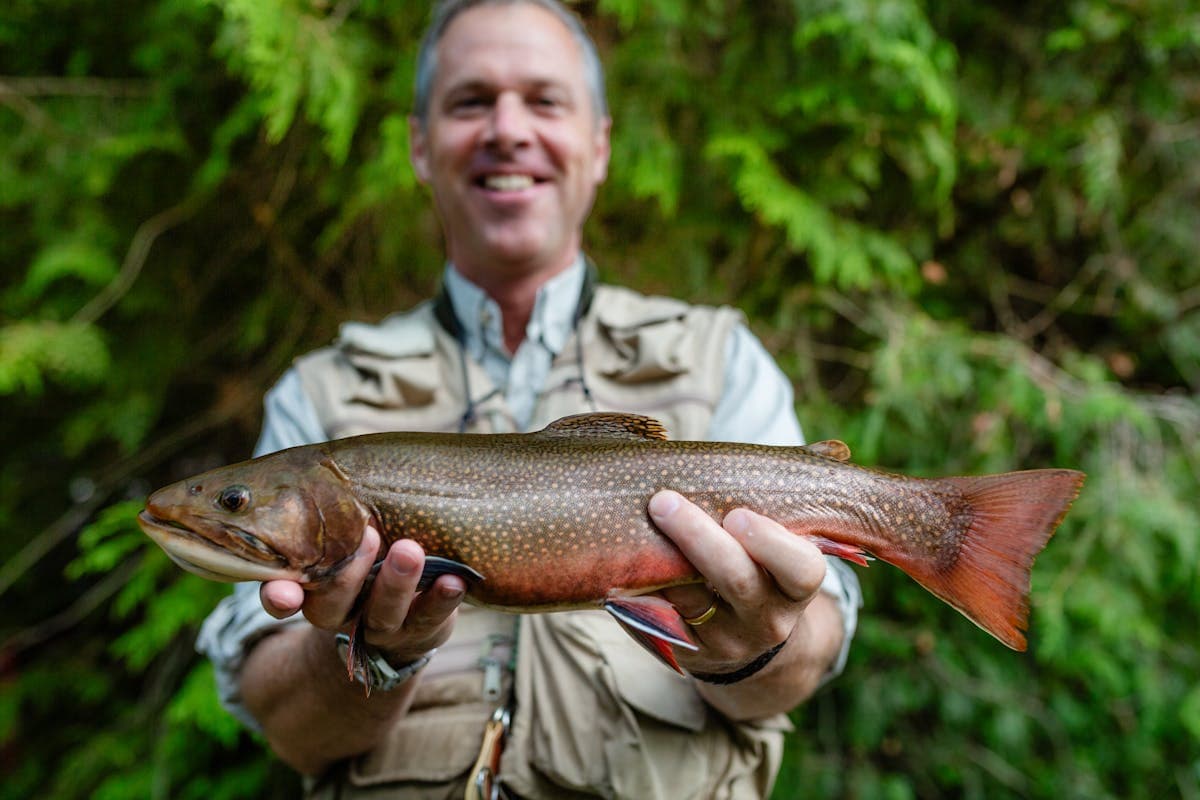
A wild brook trout -- New Hampshire's official state fish and the prize of White Mountain headwater streams
New Hampshire's wild brook trout fishing is a draw unto itself. The White Mountain National Forest holds hundreds of small tributary streams where native brookies thrive in canopied headwaters that stay cold through summer. An 8-inch fish earns bragging rights -- most run 5-7 inches -- but the experience of fishing these pristine, seldom-visited waters is the real reward.
Gear: Pack light. A 7-foot, 2-3 weight rod handles short casts in tight quarters. Foam beetles and hair-winged caddis (#14-16) cover most situations. Six-foot leaders with 6X fluorocarbon tippet. Approach from downstream and stay low.
Access: Many streams are within a short walk of popular hiking trails in the White Mountains. The Kancamagus Highway (Route 112) provides 30 miles of roadside access to the Swift River and its tributaries. Sabbaday Brook and tributaries along the highway hold small wild brookies.
Ethics: These are fragile populations. Practice catch-and-release, limit your visits to any single stretch, and leave no trace. The fish have survived here for thousands of years -- help keep it that way.
NH Fish and Game annually stocks nearly 50 backcountry ponds via helicopter with brook trout fingerlings. These fish grow to 8-10 inches by their second year, with trophy specimens exceeding 17 inches after three or more growing seasons. Light fishing pressure and clean water produce exceptional fish for their environment.
Notable remote ponds:
Pittsburg-area ponds near the Connecticut Lakes offer easier access:
Wild trout ponds are open from the fourth Saturday in April through Labor Day, catch-and-release only with barbless single hooks.
New Hampshire's fishing regulations vary significantly by water body. Always check the current eRegulations before fishing.
General rules for rivers and streams:
Key fly-fishing-only waters:
| River | Section | Special Rules |
|---|---|---|
| Connecticut River | Second CT Lake dam to Magalloway Rd | FFO, catch-and-release all species |
| Connecticut River | First CT Lake dam to Lake Francis | FFO, 2 trout daily, 12" min |
| Androscoggin | Errol Dam to Bragg Bay | FFO, 2 trout daily, 12" min |
| Androscoggin | Berlin to ME border (Sawmill Dam) | Barbless artificials, C&R year-round |
| Saco River | Lucy Brook to Artist Falls Brook | FFO, 2 trout daily |
| Ellis River | Covered bridge to Iron Bridge | FFO, 2 trout daily |
| Swift River | Rte 113A to Rte 113 | FFO, 2 trout daily |
| Sugar River | Newport (Rte 11/103 to Oak St) | FFO, 2 trout daily, Jan 1-Nov 30 |
| Mascoma River | Rte 4 bridge to covered bridge | FFO, 2 trout daily |
Licensing:
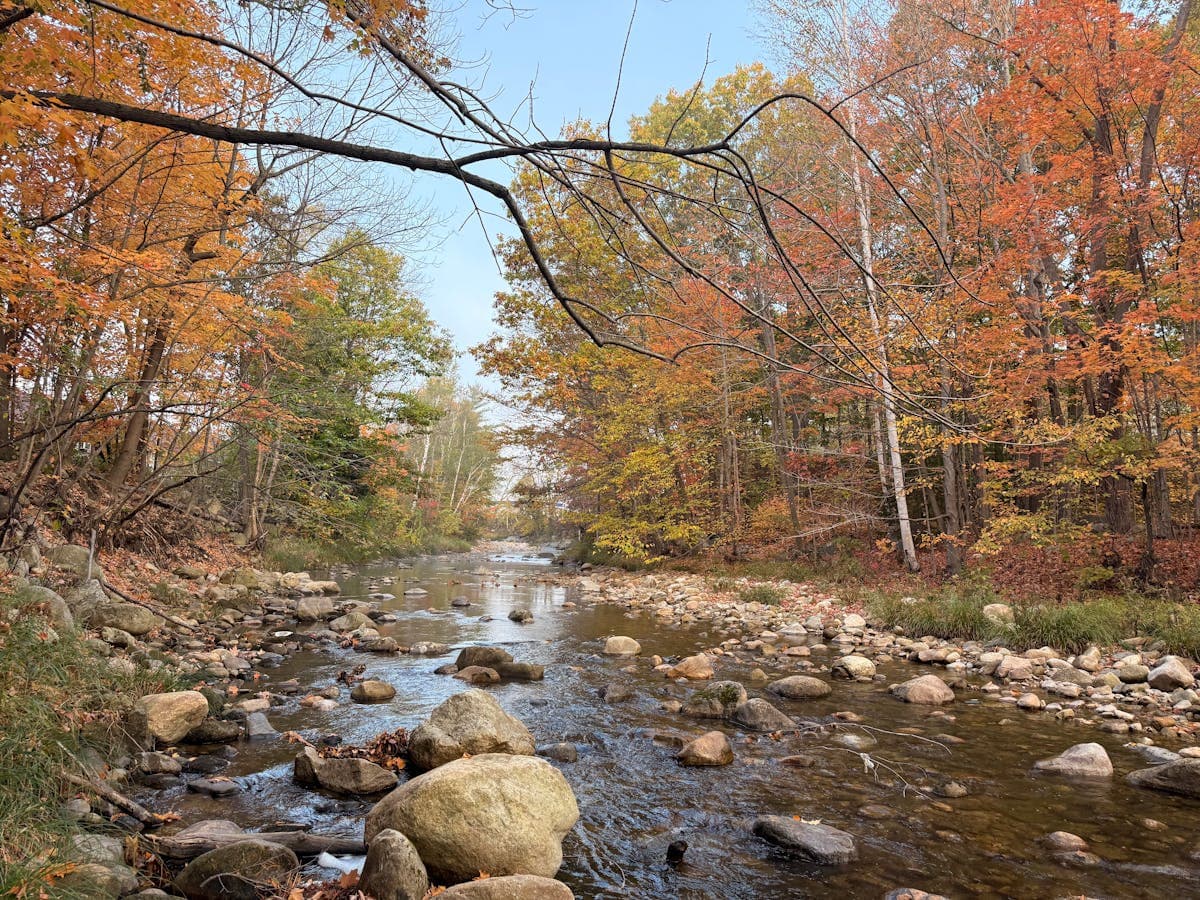
A New Hampshire river in autumn -- many of the state's best paddling runs double as fishing water
Several NH rivers offer combined fishing and floating opportunities.
Saco River: The most popular recreational paddle in the state. First Bridge to Davis Park (North Conway) is 8.5 miles of Class I water, followed by a Class II section through Conway. Below 1,000 CFS, the Saco is ideal for canoes and kayaks. Saco Bound provides shuttle service and rentals from their Conway base.
Connecticut River: New England's longest river forms NH's entire western border (and Vermont's eastern border). The Connecticut River Paddlers' Trail features hundreds of access points and 50+ primitive campsites. Day trips from Wells River to Haverhill (13 miles, beginner-friendly) or Haverhill to Orford (16 miles, moderate) offer flatwater paddling with fishing potential. Warning: Sumner Falls on the Wilder to Cornish section is dangerous -- scout first or portage.
Androscoggin River: Errol Rapids offers a reliable half-mile of Class II whitewater (Class III at high water) with dam-controlled flows. Pontook Dam releases 500 CFS on weekdays and 2,200 CFS on weekends from Memorial Day through September. Northern Waters Outfitters runs guided rafting trips ($70-80) and inflatable kayak experiences.
Pemigewasset River: The Ayers Island section near Plymouth delivers 8 miles of Class II rapids, considered one of the best regularly run stretches in New England. Raft NH operates guided trips.
| Outfitter | Specialty | Price Range |
|---|---|---|
| Lopstick Outfitters | Full-service Orvis shop, wade and drift trips on CT River | $200-$450/day |
| Tall Timber Lodge | Trophy Stretch guides, fly fishing school ($950, 3-day) | $200-$475/day |
| Northern Water Guide Service | CT River, Androscoggin, remote ponds, euro nymphing classes | $200-$450/day |
| Top Notch Fly Fishing | Androscoggin and CT River float/wade trips, NH and ME | Contact for rates |
| Outfitter | Specialty | Price Range |
|---|---|---|
| Hill Country Guides | Saco, Ellis, Androscoggin; drift and wade trips | $350-$550/day |
| White Mountain Anglers | White Mountain National Forest wild trout adventures | Contact for rates |
| The Swift River Ghillie | Conway-based; family-friendly wade and float trips | Contact for rates |
| Outfitter | Specialty | Price Range |
|---|---|---|
| NH Rivers Guide Service | Androscoggin and CT drift boats, Pemi wading, fly schools | $275-$350/day |
Most guides provide waders, boots, rods, reels, and flies. You will need to purchase your New Hampshire fishing license before arrival (required age 16+).
NH has unusually good options for learning:
The Ellis River and upper Saco FFO sections are particularly good first-time waters -- wadeable, scenic, and stocked well enough that you'll get into fish while you're learning.
The premier New Hampshire fly fishing destination. Base at Lopstick or Tall Timber.
Base in Jackson or North Conway for diverse fishing within short drives.
Cold water: NH rivers originate from snowmelt and mountain springs. Even on warm summer days, water temperatures can cause rapid hypothermia if you fall in. The body cools 25 times faster in water than in air. Spring fishing demands neoprene waders and a wading belt cinched tight.
Spring runoff: Rivers jump one or more difficulty classes during snowmelt. What was a gentle wade in August can be unfishable in April. Check flows on RiverReports before heading out.
Dams: Multiple dams across NH rivers require awareness. Low-head dams create lethal hydraulic recirculation. Never approach dams from above or below in a watercraft. Respect all posted closure areas around dam facilities and fishways.
Strainers: Fallen trees are common, especially after spring storms. Water passes through but boats and bodies can be pinned against them. Scout unfamiliar runs and keep your distance.
Didymo (rock snot): This invasive algae is present in NH waters. Clean, drain, and dry all gear between river visits. The Connecticut River requires felt-soled boot alternatives.
New Hampshire's general trout season runs from January 1 through October 15 on most rivers. The Connecticut River and its tributaries follow separate regulations. Brook trout season on many streams is catch-and-release only from October 1 through mid-April. Always check current NHFG regulations for the specific water you plan to fish.
Wetting your hands before handling a trout protects the fish's slime coat, which is its primary defense against infection and parasites. Dry hands strip away this protective layer, leaving the trout vulnerable to disease even after release. This is especially important for New Hampshire's wild brook trout populations.
The Connecticut River Trophy Stretch near Pittsburg offers the best large-trout fishing in NH. The Androscoggin River near Gorham has excellent wild brook trout and stocked browns. The Saco River near Conway is ideal for wade fishing, and the upper Ammonoosuc near the White Mountains holds native brook trout in small mountain streams.
Track real-time flows for New Hampshire rivers on RiverReports. The state page shows current conditions for the Androscoggin, Saco, Pemigewasset, Connecticut, and other monitored rivers.
How to use flow data for planning:
Compare current flows against historical averages to gauge whether conditions are normal, high, or low for the time of year. Set up flow alerts to be notified when your target river enters its ideal range.
Combining with Vermont: The Connecticut River forms the border between both states, and many anglers fish NH and VT waters on the same trip. Check our Vermont fly fishing guide for the Battenkill, White River, and other waters within easy driving distance.
Weekly flow updates and fishing intel.
© 2026 RiverReports, Inc.