Rocky River
Fishable
Flow85 CFS
Trendfalling
Clarityclear
Temp76°F
Clouser Minnows (olive/white) #2-4Bead Head Woolly Buggers (black/olive) #8-10Conehead Bunny Muddlers (white/black) #6-8-10Schultzy's Single Fly Cray (peach) #6
| What | When | Key Numbers |
|---|---|---|
| Steelhead (Lake Erie tribs) | Late Oct – Apr | Rocky: 150-250 CFS; Grand: 250-400 CFS; Chagrin: 150-350 CFS |
| Mad River brown trout | Year-round (peak Oct – May) | 50-150 CFS ideal; 10,000-15,000 browns stocked annually |
| Clear Fork trout | Oct – May (browns); Apr – May (rainbows) | 75-175 CFS; artificials-only on upper section |
| Smallmouth bass (Little Miami) | May – Sep | 100-300 CFS; 105 miles of fishable water |
| Guided steelhead trip | Book by September for fall | $400-550/day (1-2 anglers) |
| Fly shop | Mad River Outfitters | (614) 451-0363, 833 Bethel Rd, Columbus |
Ohio is not the first state most people think of for fly fishing, and that works in your favor. Check Ohio river flow data before any trip; timing your visit around clearing flows after rain events is the single biggest factor in steelhead success. The state holds three distinct fisheries that, taken together, offer year-round opportunities: Lake Erie steelhead tributaries in the northeast, spring-fed trout streams in the west-central part of the state, and some of the Midwest's best smallmouth bass rivers running through the southern half.
The steelhead program is the headline. The Ohio Division of Wildlife raises roughly 450,000 Little Manistee strain smolts annually at the Castalia hatchery, distributing them across six Lake Erie tributaries. Those fish spend two to four years in the lake, growing to 23-28 inches, before returning to tributaries from late October through May. The Mad River, a spring creek running 66 miles through Champaign and Clark Counties, supports a self-sustaining brown trout fishery fed by 10,000-15,000 stocked fingerlings each year; some grow to 16 inches and beyond. And rivers like the Little Miami, Kokosing, and Stillwater hold healthy smallmouth populations in clear, wadeable water.
Ohio's rivers don't follow a classic Western snowmelt pattern. Instead, they're driven by rainfall, agricultural runoff, and spring-fed baseflows. Here's what to expect:
| Season | Timing | Conditions | Best Bet |
|---|---|---|---|
| Winter | Dec – Feb | Cold but fishable; steelhead in deep pools, trout on midges | Steelhead Alley tribs, Mad River |
| Early Spring | Mar – Apr | Spring steelhead runs peak; trout streams clearing | Steelhead (all tribs), Mad River |
| Late Spring | May – Jun | Caddis and mayfly hatches; smallmouth season opens strong | Mad River, Little Miami, Kokosing |
| Summer | Jul – Aug | Warm water limits trout fishing; smallmouth prime | Little Miami, Stillwater, Big Darby |
| Fall | Sep – Nov | Steelhead return; brown trout aggressive; best all-around | Everything fishable |
Key timing notes:
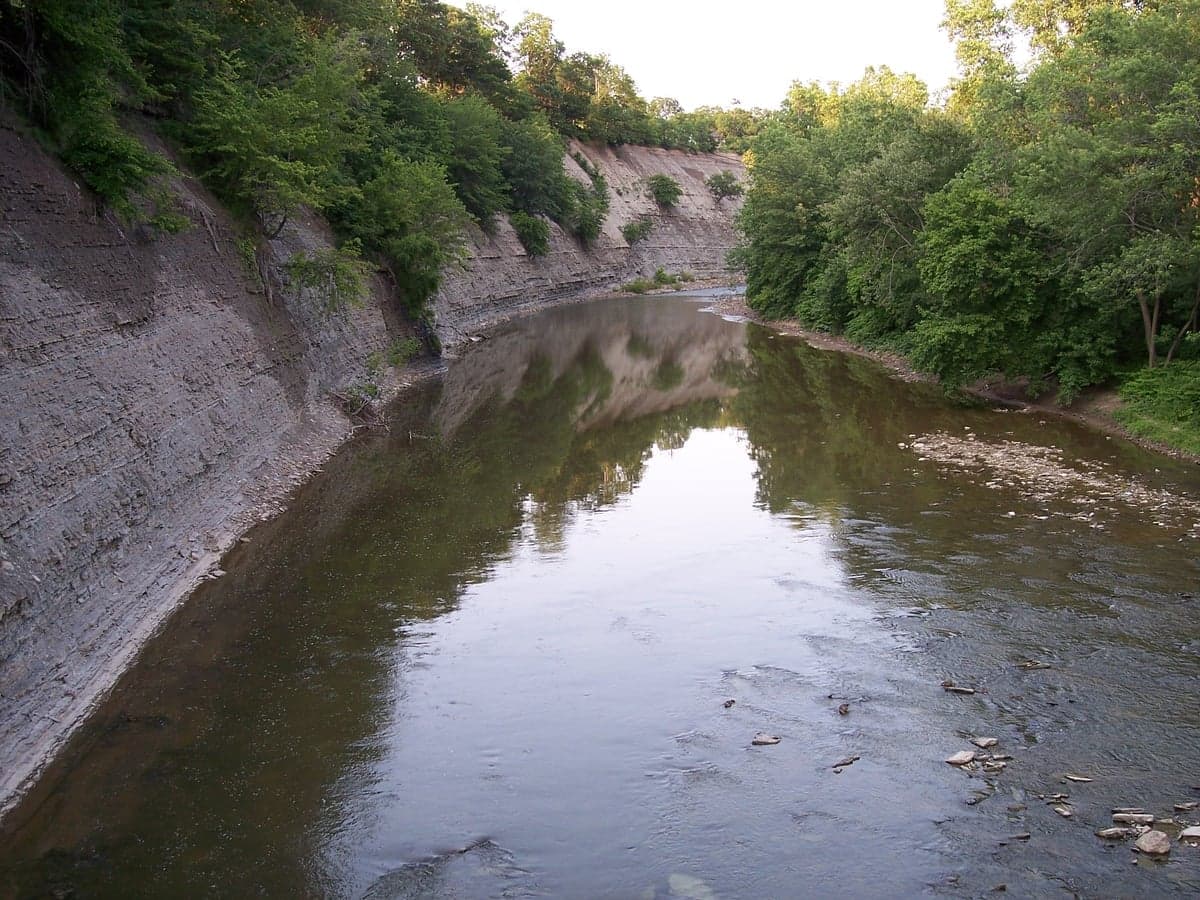
The Rocky River flowing through Cleveland Metroparks in Lakewood — possibly the most accessible steelhead fishery in the country
Ohio's steelhead fishery, known as "Steelhead Alley", spans six stocked tributaries flowing into Lake Erie's southern shore. The fish are Little Manistee River strain rainbows, stocked as 8-inch smolts that grow to 4-10 pounds (and occasionally beyond 20 pounds) after two to four years in the lake.
| River | Ideal CFS | Watershed | Clearing Time | Character |
|---|---|---|---|---|
| Vermilion | 100-200 | 268 sq mi | 3-5 days | Shale cliffs, scenic gorges |
| Rocky | 150-250 | 175 sq mi | 2-3 days | Urban, easy access near Cleveland |
| Chagrin | 150-350 | 264 sq mi | 2-3 days | Within 30 min of downtown Cleveland |
| Conneaut | 200-350 | 190 sq mi | 3-4 days | Wild and Scenic designation |
| Grand | 250-400 | 705 sq mi | 5-7+ days | Largest watershed; best float fishing |
| Ashtabula | , | 137 sq mi | 2-3 days | Clears first after storms |
Track all of these on RiverReports Ohio to time your trips around clearing flows.
The Rocky sits inside Cleveland Metroparks, making it possibly the most accessible steelhead fishery in the country. Field and Stream named it one of "150 Best Places to Fish in America." The river is shallow, meandering, and easy to wade on a shale and silt bottom. Abandoned fords create ideal holding water.
Access: 13 DNR-designated fishing areas including Emerald Necklace Marina, Morley Ford, Cedar Point Road Bridge, and Horse Ford. All accessible via Cleveland Metroparks.
Flows: Fish the drop, the prime window is when flows settle back toward 150-250 CFS after rain, with enough color to give fish confidence but enough clarity to see your indicator. Check Rocky River flows on RiverReports.
Gear: 9-foot 6-7 weight with floating line and 3X-5X fluorocarbon tippet. Spey and switch rods (11-12 feet) work well for swinging. The Rocky's resident forage includes emerald shiners and gizzard shad, match those profiles with streamers.
Ohio's largest Lake Erie tributary with over 50 miles of fishable water. The Grand gets excellent returns of both fall (Pennsylvania strain) and spring (Manistee strain) steelhead, and it's the best Steelhead Alley river for float fishing. Covered Bridge Outfitters Lodge, an Orvis-endorsed operation in Conneaut, runs guided drift boat trips.
The tradeoff: the Grand's large watershed means it takes the longest to clear after storms, plan on a week or more of recovery time. When it's in shape at 250-400 CFS, though, it's arguably the best steelhead water in the state.
A consistent producer and arguably the most popular steelhead river among Northeast Ohio fly anglers. The Chagrin originates in Geauga County and drops at a moderate gradient through shale-bottomed runs and pools to Lake Erie, all within 30 minutes of downtown Cleveland. The main stem is Class I water, easily wadeable with felt or studded boots on the slick shale substrate. Water typically runs tea-stained after rain, clearing to a green-grey tint at fishable levels.
Access: Daniels Park and Todd Field provide the best public wading access through Lake County Metroparks. The East Branch (Class II, 4.7 miles from Mitchell Mills Road to Daniels Park) holds fish too and sees less pressure. Cleveland Metroparks (440-234-9597) and Lake County Metroparks (800-227-7275) maintain access maps.
Flows: Fish at 150-350 CFS. The Chagrin clears in 2-3 days after storms, faster than the Grand but slower than the Ashtabula. Mornings can be slow in winter; the best action typically runs 11am to 3pm when water temps nudge upward. Nymph under an indicator in the deeper pools, and swing streamers through the tail-outs on warmer days.
Chagrin River Outfitters in Chagrin Falls is the local authority; they offer guided trips ($400-550), steelhead-specific instruction ("Steelhead 101"), fly tying classes, and carry current intel on all the northeast Ohio tribs. They'll supply rods, waders, and boots with advance notice. Phone: (440) 247-7110.
For a deep dive into the Chagrin: including section-by-section access, flow chart interpretation, seasonal tactics, and fly selection, see our complete Chagrin River Fishing Guide.
One of the top steelhead tributaries on Lake Erie, Conneaut Creek earned a State Scenic River designation across a 21-mile stretch in 2005. It holds steelhead, bass, northern pike, walleye, and 78 other documented species. Access via Lakeville Park and Conneaut Harbor.
Covered Bridge Outfitters offers private water access on Conneaut Creek plus luxury lodge accommodations on a 135-acre property. Phone: (440) 256-6556.
Known locally as "the V," the Vermilion gets excellent spring-run steelhead returns. Orvis fishing reports call it "our best tributary in western Ohio." The lower river runs through spectacular shale gorges managed by Lorain County Metro Parks, with eight designated access points from the Municipal Boat Ramp upstream to Wakeman Dam.
Flows: Fish at 100-200 CFS. Clearing time is 3-5 days after rain.
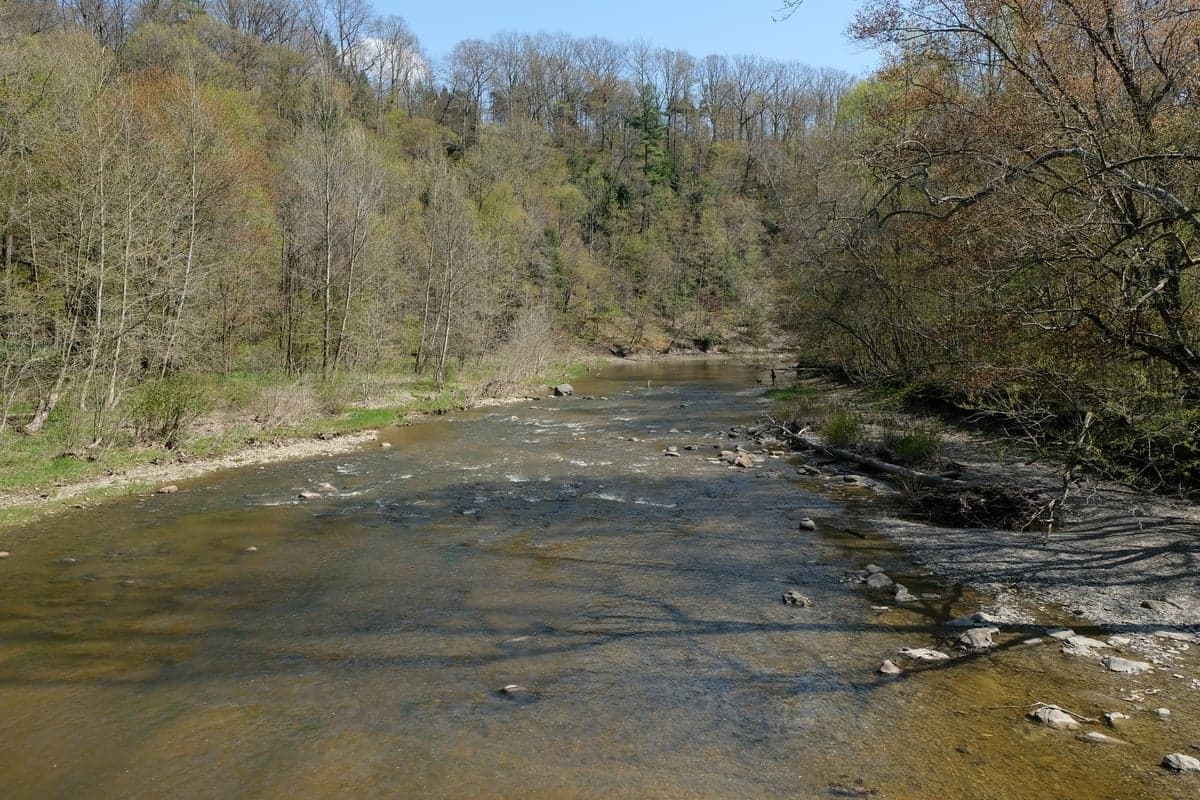
The Ashtabula River from the Riverview Covered Bridge — the Ashtabula clears first after storms and gets less angling pressure than the larger tributaries
| Season | Patterns | Sizes |
|---|---|---|
| Early fall (Oct-Nov) | Egg-Sucking Leeches, Woolly Buggers (black, olive), Clouser Minnows | 6-10 |
| Winter (Dec-Feb) | Glo Bugs, Sucker Spawn (cream/chartreuse), Pheasant Tails, stonefly nymphs | 10-16 |
| Spring (Mar-May) | White/Pink Sucker Spawn, Woolly Buggers (black, purple), egg patterns | 8-12 |
| Year-round | Gold Bead Hare's Ear, Prince Nymphs, Zebra Midges | 12-18 |
Technique tip: In fall, fish respond to swung streamers and actively stripped flies. As water temperatures drop through the 40s and into the 30s, shift to dead-drifted eggs and nymphs under an indicator; it becomes the most effective method by December. Use 3X tippet in stained water; step down to 5X-6X fluorocarbon on 10-12 foot leaders in clear conditions.
The Mad River is probably Ohio's most famous fly fishing river and its only significant year-round trout stream. Spring-fed from headwaters near Zanesfield in Logan County, it flows 66 miles south through Champaign and Clark Counties before joining the Great Miami River near Dayton. The springs keep water temperatures cool enough for trout even in summer, when the flow becomes crystal-clear with a slight golden hue and every stone is visible on the bottom.
The Ohio Division of Wildlife stocks 10,000-15,000 brown trout fingerlings (6-8 inches) annually, and fish commonly reach 14-16 inches with holdovers growing larger. The upper river near West Liberty also holds native brook trout in the headwaters, a rarity in Ohio. Brian Flechsig of Mad River Outfitters literally wrote the "Fly Fisher's Guide to the Mad River" and has been guiding here since 1989.
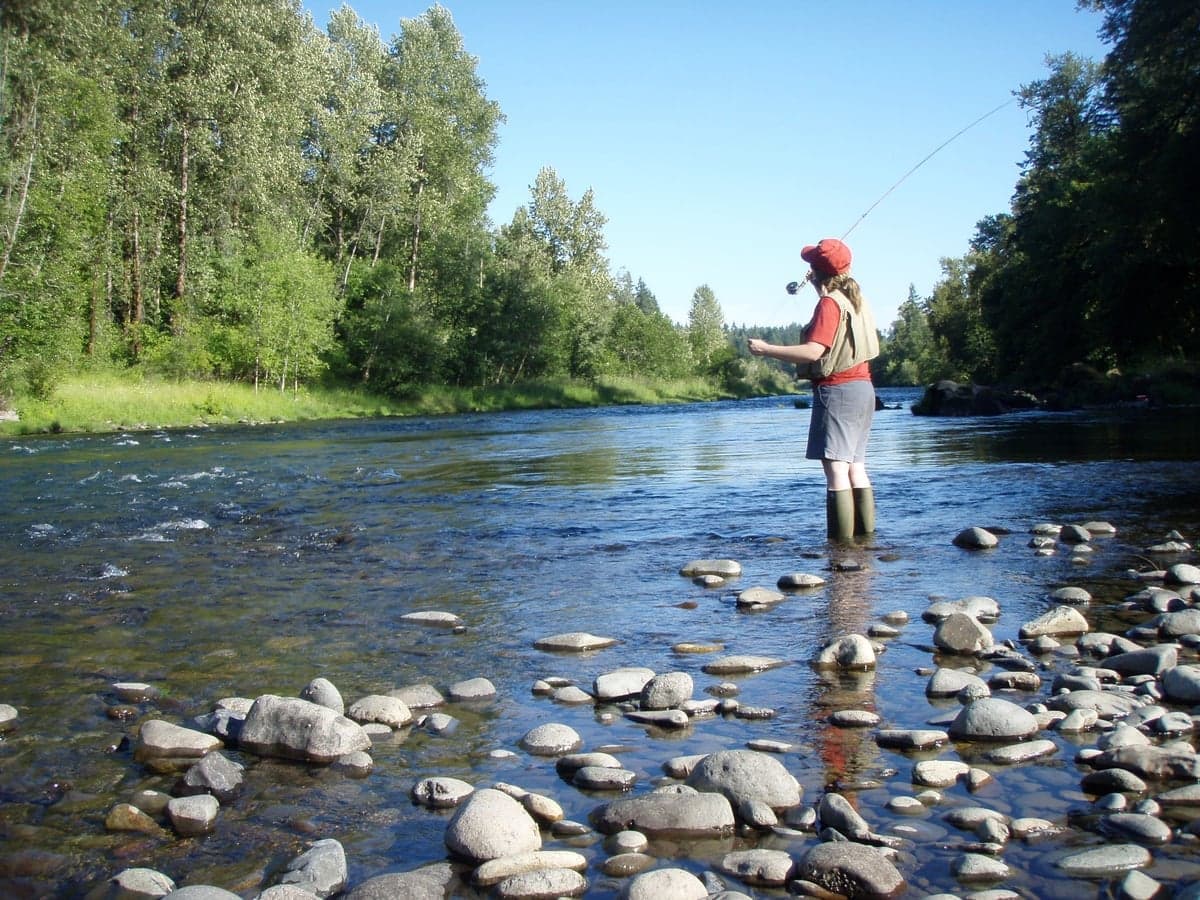
Working a fly line on a spring creek — the Mad River's crystal-clear water demands long leaders, stealth, and a drag-free drift on the first cast
| Insect | Size | Timing | Recommended Patterns |
|---|---|---|---|
| Midges | 20-24 | Year-round | Zebra Midge, Griffin's Gnat |
| Little Black Stoneflies | 12-18 | Late Feb – Mar | Black Stonefly Nymph |
| BWO / Blue Winged Olives | 18-22 | Mar – Sep, Nov – Dec | Pheasant Tail Klinkhammer, Polar Crippled Olive |
| Green Sedge / Caddis | 14-18 | Feb – Apr | Apple Caddis, Elk Hair Caddis |
| Sulphurs | 14-16 | May – Jun | Sulphur Dun |
| Light Cahill | 12-14 | May – Jun | Light Cahill |
| Brown Drakes | 10-12 | May – Jun | Brown Drake emerger |
| March Browns | 10-14 | May | March Brown |
| Tricos | 22-26 | Jul – Oct | Trico Spinner |
| Terrestrials | 10-16 | Jun – Oct | Ant, beetle, hopper patterns |
As one local angler put it: "The Mad is full of caddisflies, so many that I seldom use anything else." When in doubt, tie on a caddis pattern.
Mad River Outfitters runs walk-and-wade trips on the Mad River for $425 (1-2 anglers) and float trips for $525. Their guide staff includes specialists in brown trout streamers, smallmouth bass, and Lake Erie steelhead.
The Clear Fork is actually two fisheries in one:
Upper Clear Fork (above Pleasant Hill Reservoir): Fingerling and yearling brown trout stocked each fall. Less fishing pressure than most Ohio trout waters. Special regulation water near Bellville-Butler requires artificial flies and lures only, with a one-trout, 10-inch minimum creel limit. Some browns grow past 20 inches. Best access at bridge crossings near Butler and Bellville, private land limits some bank access.
Lower Clear Fork (Pleasant Hill Dam through Mohican State Park): Catchable rainbow trout stocked in spring, plus smallmouth, panfish, and saugeye. Excellent access through the state park. The covered bridge at the Class B Campground is a scenic and productive starting point.
The Mohican Fly Fishers of Ohio consider the Clear Fork the cleanest river in the state. Ideal flows are 75-175 CFS. Hatches include Light Cahills from late May through July and midges year-round. Nymphing is the most productive approach outside of active hatches.
Check Clear Fork flows on RiverReports before making the drive.
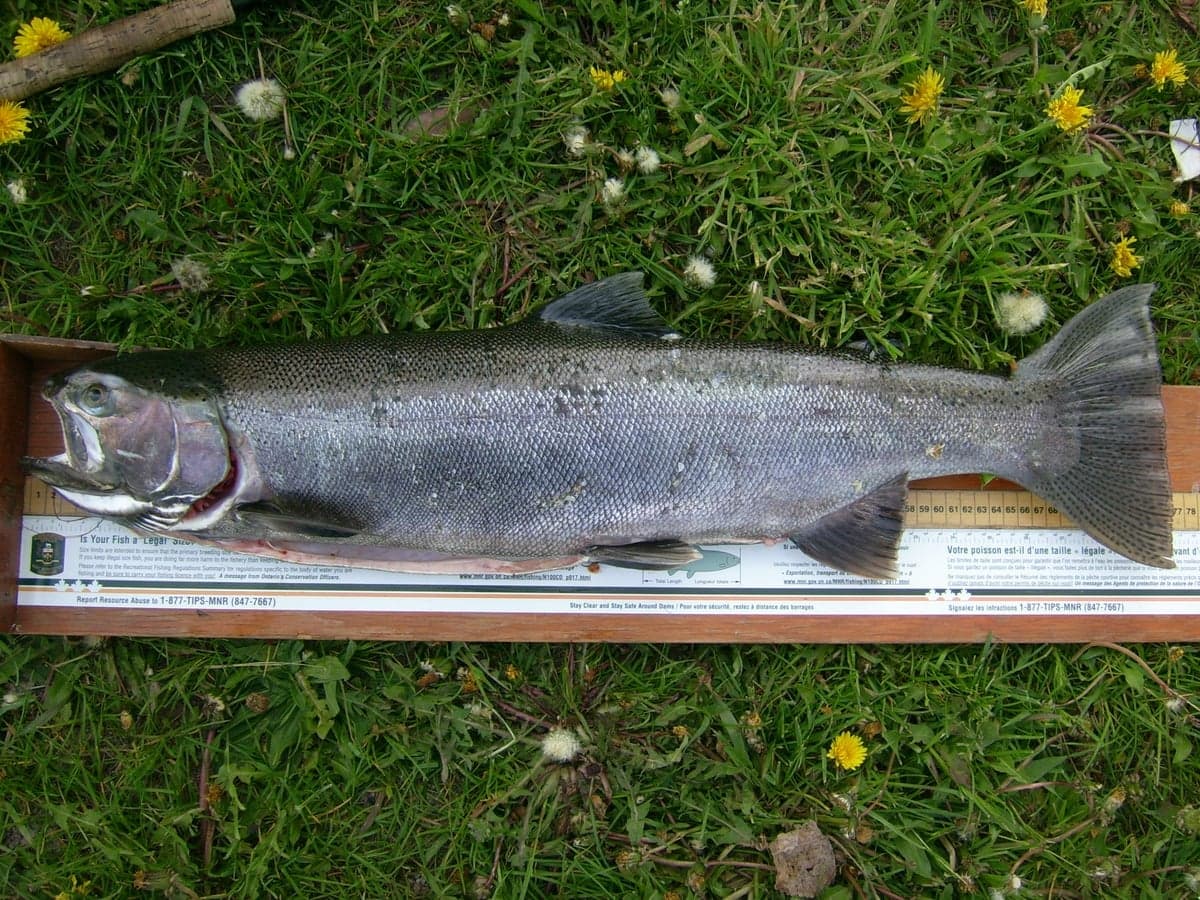
A keeper rainbow trout — Ohio stocks catchable rainbows in the Clear Fork, Clear Creek, and Cold Creek, with some holdovers reaching 18 inches
Ohio is a "sleeper state" for smallmouth fly fishing, as Mad River Outfitters puts it. Catch rates on streams often exceed reservoirs because fish concentrate in specific pools, riffles, and current seams. The season runs May through October, with peak action from June through September when water temps push smallmouth into aggressive feeding.
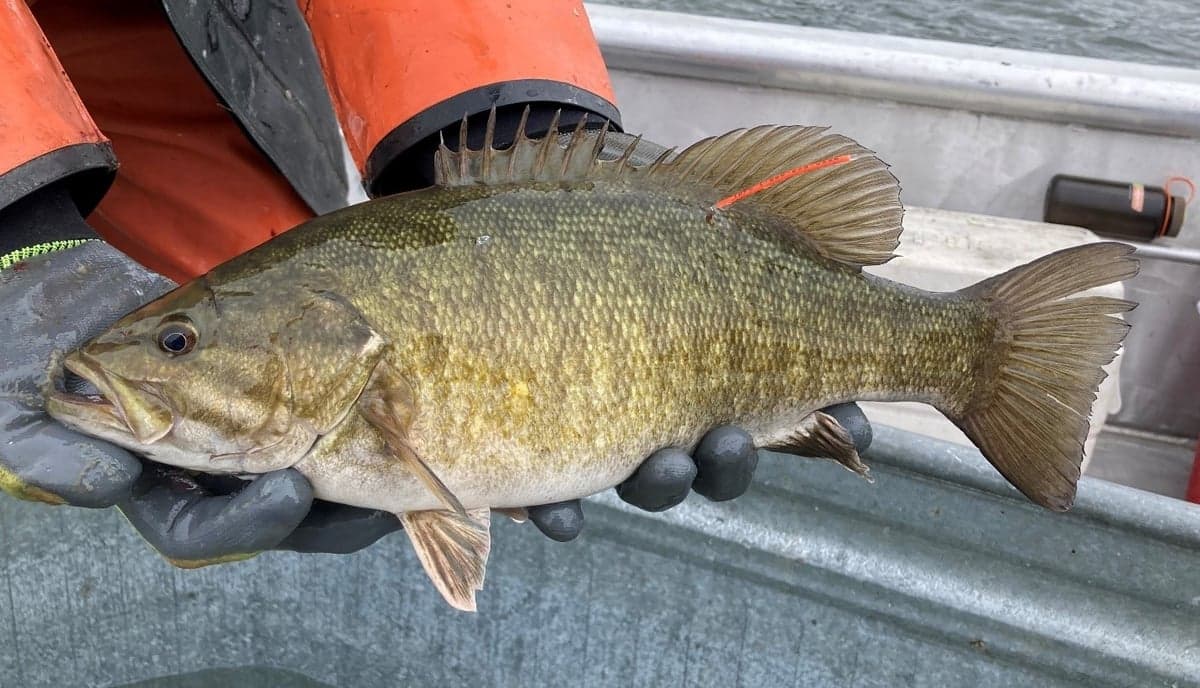
A smallmouth bass — Ohio's rivers like the Little Miami, Kokosing, and Stillwater hold healthy populations in clear, wadeable water
| Water Condition | Patterns | Sizes | When |
|---|---|---|---|
| Clear/low water | Clouser Minnows, crayfish patterns, Deer Hair Divers | 2-6 | Morning and evening |
| Moderate flows | Woolly Buggers (olive, black), bass poppers, foam hoppers | 4-8 | All day in summer |
| Higher/stained water | Zonkers, large streamers, dark Woolly Buggers | 2-6 | Midday |
| Topwater (best Jun-Sep) | Poppers, Dahlberg Divers, gurgler patterns | 4-8 | Dawn and dusk |
Use a 5-6 weight rod with 2X-3X tippet. Floating line for poppers and shallow runs; sink-tip for deeper pools and undercut banks. Target current seams, laydown logs, larger rocks, and shaded banks. Early morning and late evening produce the best topwater action.
A 105-mile National Scenic River running through southwest Ohio, the state's most accessible and diverse warm-water fly fishery. The Little Miami holds smallmouth, largemouth, spotted bass, rock bass, and channel catfish. The water runs over a gravel and cobble bottom with limestone ledges, typically 2-4 feet deep with pools reaching 6+ feet. In summer, you'll see crayfish and minnows darting under every rock; the forage base is excellent.
Flows: 100-300 CFS ideal for smallmouth. Below 75 CFS and you'll be scraping. The upper sections near Clifton Gorge (Class II-IV, access restricted) are scenic but not fishable by kayak. The best fishing-floating water starts below John Bryan State Park.
Float logistics: Six distinct paddling sections covering 86 total miles. Best for fishing: John Bryan State Park to Glenn Thompson Reserve (12 miles, full day) or Caesar Creek Access to Halls Creek (14 miles, full day). Multiple liveries simplify shuttle logistics:
Stocked trout are available October through April in the upper sections, switch to egg patterns and San Juan Worms (#10-14) during the colder months.
A 28-mile state scenic water trail with nine access points, all with parking and portable restrooms. The Kokosing is a pretty river, steep sandstone cliffs with scattered boulders, wooded banks, and clear water averaging 2-3 feet deep. Smallmouth are abundant throughout the main stem from Mount Vernon to the Walhonding confluence. Most fish run 10-12 inches, with occasional 18-inch fish holding in deeper pools behind large rocks and alongside downed timber.
Float logistics: The best fishing stretch runs from Gambier to Howard (7.4 miles, 3-4 hours). Kokosing Valley Campground and Canoe Livery handles shuttles ($15). The river floats best at 100-200 CFS: below 70 CFS, expect ankle-deep riffles and portaging. "The Factory Rapids" (remnants of a historic dam, Class II) is the only real whitewater and can be portaged on the left bank.
Best approach: Concentrate on deeper pools, larger rocks, and faster-moving water. Jig-style flies and Rebel Craw-colored Clousers work well. Poppers against shaded cliff faces at dawn and dusk can produce explosive takes.
The Stillwater and Greenville Creek system is the only Ohio river designated as both a National Water Trail and a State Scenic River. The upper river holds wild brown trout, a genuine rarity in Ohio, while the lower sections host what's been called "one of the best smallmouth bass fisheries in the United States" with 59 documented fish species. The bottom is clean gravel and rock, and the water clarity is typically excellent.
Access: Englewood MetroParks off U.S. 40 provides the main put-in. A popular float runs 12 miles from Englewood to Sibenthaler Bridge (roughly 4 hours). The first section below Englewood Dam has four small drops that are fun in a kayak but can surprise beginners. Below that, it's calm and shallow Class I water through undeveloped corridor with minimal houses, a peaceful float.
Flows: Trout section: 40-120 CFS. Bass section: 100-250 CFS. Access through Five Rivers MetroParks near Dayton.
Home to roughly 100 fish species and 44 freshwater mussel species, Big Darby is classified as "Exceptional Warmwater Habitat", possibly the cleanest creek in the Midwest. The water is remarkably clear over a gravel bottom, and the biodiversity here is genuinely impressive.
Float logistics: A popular 5-mile float from Alkire Road to Osprey Lake runs through Battelle Darby Creek Metro Park west of Columbus. Free access, no fees, free parking. A longer option: SR 736 to Prairie Oaks Metro Park (7 miles, about 2.5 hours). Best from Memorial Day through mid-July when water levels support paddling, this is a free-flowing creek that gets too low by late summer. Target largemouth, smallmouth, and rock bass in the deeper bends and along undercut banks.
Worth mentioning for its unique setting: the Cuyahoga flows through Cuyahoga Valley National Park for roughly 22 miles, offering fly fishing within a national park. The lower river receives steelhead runs from Lake Erie, and the park sections (Class I, Ira Road to Route 303) hold smallmouth, rock bass, and other warm-water species in a surprisingly scenic forested corridor.
Access: Seven NPS access points from Northampton Point (mile 36.7) to Lock 39 Trailhead (mile 13.2). The river fishes best for steelhead at 250-350 CFS, but takes a week or more to clear after rain. A valid Ohio fishing license is required; only human-powered boats allowed.
Note: Post-rain water quality can be poor due to combined sewer overflows, the park posts daily bacteria advisories May through October. Fish here on dry-weather windows.
Clear Creek: The closest trout fishing to Columbus (40 minutes southeast). Catchable rainbow trout stocked in fall. Two-fish limit, 12-inch minimum. Access via Clear Creek MetroPark. A put-and-take fishery, but holdovers to 18 inches aren't uncommon.
Macochee Creek: A small, intimate Mad River tributary near West Liberty. Several hundred yearling brown trout stocked annually, with fish reaching 12-16 inches. Bring a 7-foot, 4-weight rod, this is tight-quarters fishing with brush and tall grass on both banks. Access at the designated site on T-47 east of West Liberty.
Apple Creek: A freestone stream through Grosjean Park in Wooster stocked with rainbow and brown trout twice annually by the Chagrin Falls Chapter of Trout Unlimited. Catch-and-release encouraged. Good for small dry flies. Adams (#14-16), Hare's Ear nymphs, Pheasant Tails, and Rainbow Warriors all produce. The creek stays cool year-round thanks to spring inputs.
Cold Creek (Castalia): Spring-fed tributary near the Castalia State Fish Hatchery. Stocked with thousands of rainbow trout annually. The catch: all adjacent land is private. A half-mile section is available May through November via an annual March lottery. Cold Creek Trout Camp also offers public access for a fee.
Ohio has no designated trout season, trout fishing is open year-round on streams with established populations. Key regulations:
Always check current Ohio Division of Wildlife regulations before your trip, regulations change annually.
| Shop | Location | Phone | Specialty |
|---|---|---|---|
| Mad River Outfitters | Columbus | (614) 451-0363 | Trout, steelhead, smallmouth; guides statewide |
| Chagrin River Outfitters | Chagrin Falls | (440) 247-7110 | Steelhead, NE Ohio tribs, fly tying classes |
| Covered Bridge Outfitters | Conneaut | (440) 256-6556 | Orvis-endorsed; steelhead lodge, float trips |
| The Steelhead Guide | Cleveland area | (440) 773-8064 | 30+ years steelhead guiding |
Orvis Fly Fishing School: Rockwell Springs Trout Club near Clyde offers 1-day ($339) and 2-day ($589) schools on 125 acres of spring-fed streams with rainbow, brook, brown, and tiger trout. A 4:1 student-to-instructor ratio.
Local clubs: Miami Valley Fly Fishers (Dayton area), Buckeye United Fly Fishers (Cincinnati), Central Ohio Fly Fishers (Columbus), and the Chagrin Falls TU Chapter all hold regular meetings and maintain access information.
Ohio fly fishing is relatively low-risk compared to Western mountain rivers, but a few things to watch:
Track real-time flows for all Ohio rivers on RiverReports. Here's how to use it for Ohio fly fishing:
For more background on steelhead fishing across the region, see our Great Lakes Steelhead Fishing guide.
Ohio offers year-round fly fishing, but the peak windows depend on what you are targeting. Steelhead fishing on Lake Erie tributaries peaks in December and again from mid-March through April. The Mad River fishes well year-round thanks to its spring-fed flows, with the best dry fly action from April through June during overlapping mayfly and caddis hatches. Smallmouth bass fishing on rivers like the Little Miami and Kokosing peaks from June through September. Fall (September-November) is arguably the best all-around season when steelhead return, brown trout become aggressive, and smallmouth are still active.
The top Ohio steelhead rivers are the Rocky River (most accessible, right in Cleveland Metroparks), the Chagrin River (consistent producer within 30 minutes of downtown Cleveland), the Grand River (largest tributary with the best float fishing), and Conneaut Creek (Wild and Scenic designation, heavy stocking from both Ohio and Pennsylvania). The Vermilion River is the best western Ohio option with excellent spring returns. Each river has different clearing times after rain: the Rocky and Chagrin clear in 2-3 days, while the Grand River can take a week or more. Track them all on RiverReports Ohio flow data.
Absolutely. The Mad River is Ohio's only significant year-round trout stream and arguably the best dry fly fishing in the state. Spring-fed flows keep water temperatures cool enough for brown trout even in summer. The Ohio Division of Wildlife stocks 10,000-15,000 brown trout fingerlings annually, and holdover fish commonly reach 14-16 inches. The hatch calendar is extensive: midges year-round, BWOs in spring and fall, caddis from February through April, sulphurs and Light Cahills in May-June, and tricos in late summer. When every steelhead tributary is blown out after a rainstorm, the Mad River is often still fishable.
For steelhead, bring a 9-10 foot rod in 7-8 weight with floating line and 3X-5X fluorocarbon tippet. Spey and switch rods (11-12 feet) work well for swinging on the Grand River and Rocky River. For Mad River trout fishing, an 8-9.5 foot rod in 4-5 weight with 5X-6X tippet is standard. The clear spring creek water demands long leaders (9-12 feet) and stealth. For smallmouth bass on the Little Miami or Kokosing, a 5-6 weight rod with 2X-3X tippet covers poppers and streamers. Studded wading boots are essential on Steelhead Alley's slippery shale bottoms.
Weekly flow updates and fishing intel.
© 2026 RiverReports, Inc.