Quick Reference
| What | When | Key Numbers |
|---|
| Winter steelhead | Dec-Mar (wild peak Feb-Mar) | 10-12 lb avg; 20+ lbers possible; emerald water = game on |
| Hoh River flow | USGS 12041200 | Under 2,500 CFS ideal; fishable to 4,000 CFS |
| Upper Hoh (park) | Fly-fishing only section | Hoh Campground to park boundary; closed Jun 1 for spawning |
| Middle Hoh | Best float water | Morgan's Crossing to Oxbow; ~8.5 river miles |
| Lower Hoh | Tidewater to Cottonwood | Oil City Road access; fish staging near tidewater |
| Guided trips | Book for Feb-Mar peak | $650-750/day; drift boat included |
| License | WA license + steelhead punch card | Wild steelhead must be released |
Flow890 CFS at USGS 12041200 — summer low flows, ~60% of the ~1,500 CFS seasonal median
Trendstable
Claritygin-clear with faint glacial tint; high visibility in shallows
Temp~55-57°F
Sea-run cutthroat (primary target): Elk Hair Caddis #14-16Stimulator #8-12Royal Wulff #12-14PMD #16-18
FORECASTThe Hoh is running at 890 CFS — below median but fishable — and sea-run cutthroat 8-20 inches are the primary target through September. Dry flies and small streamers in riffles and pool tailouts at dawn and dusk are producing well. Summer steelhead are effectively done for the year. The river needs rain to push flows back toward the 1,500-2,500 CFS emerald-green sweet spot. The first fall rains (typically mid-September to early October) will refresh the system and begin staging early-returning winter steelhead. Until then, fish dawn and dusk exclusively with maximum stealth — long leaders, small flies, downstream approaches only. Sol Duc, Bogachiel, and Calawah offer excellent backup options and clear 12-24 hours faster than the Hoh after storms. Winter steelhead season reopens December 1, 2026. Book February-March 2027 guided trips now with Waters West, Emerald Water Anglers, or Anadromy — prime dates fill by November.Late summer on the Olympic Peninsula — still the driest stretch of the year but approaching the seasonal transition. The Hoh is at 890 CFS, roughly 60% of the ~1,500 CFS seasonal median, with recent brief rain bumping flows up from last week's 566 CFS low. Expect highs near 68-75°F with variable cloud cover and marine fog mornings. Water temps around 55-57°F — warm enough that fish are most active at dawn and dusk. Late August into September typically brings the first hints of fall weather: occasional frontal systems pushing brief rain through the valley. Each rain pulse will refresh flows before receding again. When sustained rain finally arrives, calculate your drive time to Forks and plan to be on the water as the gauge drops through 2,000 CFS on the falling limb — that first emerald water after a summer rain event can produce explosive cutthroat fishing.
Before You Go
The Hoh River is the crown jewel of Olympic Peninsula steelhead fishing and, for many fly anglers, the finest wild steelhead river in the Lower 48. It flows 56 miles from the glaciers of Mount Olympus through one of the last temperate rainforests on Earth before meeting the Pacific Ocean south of La Push. The valley receives 12-14 feet of rain annually. Moss hangs from every branch. Old-growth Sitka spruce tower 300 feet overhead. And somewhere in that emerald water, wild steelhead averaging 10-12 pounds are holding in the current, waiting for your fly to swing through their lie.
This is not easy fishing. The Hoh demands patience, flexibility, and a tolerance for getting rained on. You might drive four hours from Seattle, arrive to find the river at 15,000 CFS and the color of chocolate milk, and spend two days waiting for it to drop. But when it does -- when the gauge reads 2,200 CFS and the water turns that signature blue-green -- you are fishing some of the most storied steelhead water on the planet.
The Hoh produces wild steelhead that routinely exceed 15 pounds, with 20-pounders caught every season. These are not hatchery fish stacked at a dam. They are ocean-bright, glacier-fed, wild fish that have navigated 20 miles of Pacific shelf to reach their natal gravel. When one grabs your swung fly in three feet of emerald water, you will understand why people reorganize their winters around this river.
If you are new to the Olympic Peninsula, we also maintain a broader Olympic Peninsula fly fishing guide covering the Sol Duc, Bogachiel, Calawah, Quillayute, and Lake Crescent. The Hoh guide here goes deeper on this specific river.
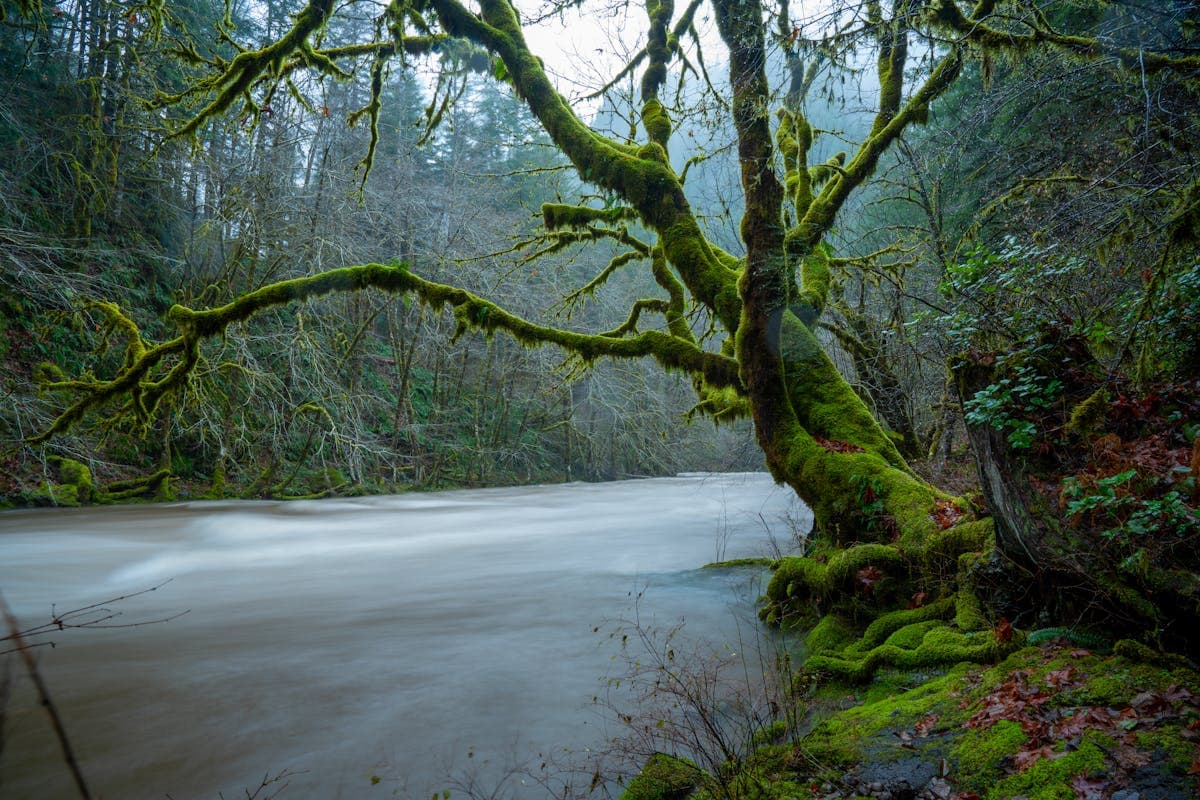
The Hoh River valley receives 12-14 feet of rain annually, creating the lush temperate rainforest that defines this fishery.
Understanding Hoh River Flow
Flow data is the single most important tool for planning a Hoh River trip. This is a rain-fed system with glacial meltwater influence, and conditions can change from unfishable to perfect in 48 hours.
The Gauge
The primary gauge is USGS 12041200 (Hoh River at US Highway 101 near Forks, WA). Check it on RiverReports before every trip and throughout the day while fishing.
Hoh River CFS: What the Numbers Mean
| Hoh River Flow (CFS) | Conditions | Fishability |
|---|
| Under 1,000 | Low and clear | Fishable but fish are spooky; long leaders, smaller flies |
| 1,500-2,500 | Ideal range | Emerald green water; best visibility; prime swing water |
| 2,500-4,000 | Higher but fishable | Off-color water; nymphing more productive; experienced anglers |
| 4,000-8,000 | Marginal | Dangerously fast; limited wading; not recommended |
| Over 8,000 | Blown out | Unfishable; wait for it to drop |
The magic number most guides cite is under 2,500 CFS. At this level, the Hoh takes on its characteristic emerald green color -- a visual signal that visibility is good enough for fish to see a swung fly from several feet away. Above 3,000 CFS, the glacial silt and storm runoff reduce visibility, and you are better off nymphing deep or waiting another day.
Reading Weather Patterns
The Hoh is a rain-driven system. Your success depends on timing around storm cycles:
- Storm arrives: River begins rising. Unfishable within hours.
- Peak flood: The Hoh can spike from 2,000 to 40,000 CFS in 24 hours during major storms (this happened in the 2002 Christmas storm with 6 inches of rain). Stay home.
- Dropping and clearing (THE SWEET SPOT): As rain tapers, the river drops 500-1,000 CFS per day. Fish settle into lies. Visibility improves. This is when you want to be on the water.
- Low and clear: Good fishing continues but fish become spookier with increasing visibility.
The practical approach: Watch the 10-day forecast. Book your trip around a weather window where rain is followed by 2-3 dry days. The Hoh typically needs 48-72 hours after a major storm to drop into fishable shape. Guides check the gauge data at least twice daily and will switch rivers (to the Sol Duc or Bogachiel) if the Hoh is not cooperating.
Glacial influence: Unlike pure rain-fed rivers, the Hoh receives glacial meltwater from Mount Olympus. This means it carries a slight milky tint even in low water and never achieves the crystal clarity of a freestone river like the Bogachiel. That glacial flour actually helps -- it provides just enough color to give fish confidence and make your leader less visible.
Water Temperature and Technique
Water temperature drives steelhead behavior on the Hoh more than any other variable. Check temps with a stream thermometer -- most guides carry one.
| Water Temp (°F) | Fish Behavior | Best Technique | Fly Choice |
|---|
| Below 38 | Nearly dormant; hugging bottom | Deep nymphing, slow dead-drifts | Eggs, beads, weighted nymphs |
| 38-42 | Sluggish; will not move far | Indicator nymphing, slow swing | Eggs, Glo Bugs, small intruders |
| 42-46 | Becoming active; will move 1-2 ft | Nymphing or slow-swung flies | Hoh Bo Spey, smaller intruders |
| 46-50 | Active; will chase 3-4 ft | Swinging flies -- prime conditions | Intruders, tube flies, GP |
| 50+ | Aggressive; rare in winter | Swinging, waking flies possible | Muddlers, waking patterns |
On the Hoh, December and January water temps typically run 38-42 degrees. February warms to 42-46 degrees, and March often reaches 46-50 degrees -- which is why March produces the best swing fishing of the season.
River Sections
The Hoh can be broken into three distinct sections, each with its own character and access considerations.
Upper Hoh (Olympic National Park)
The upper Hoh flows through Olympic National Park, where old-growth Sitka spruce, western red cedar, and Douglas fir create a cathedral-like canopy over the river. This is the fly-fishing-only section.
Key details:
- Fly-fishing only from Hoh Campground downstream to the park boundary
- Closed through June 1 each year for wild steelhead spawning protection
- When open (December 1 - March 31), this is walk-and-wade water only -- no drift boats
- Fish hold in classic runs with gravel bars, logjam tailouts, and braided side channels
- The park boundary is roughly 13 miles from the Hoh Rain Forest Visitor Center trailhead
Access: Drive Hoh River Road (Upper Hoh Road) 18 miles from Highway 101 to the Hoh Rain Forest Visitor Center and campground. The fly-only water extends downstream from the campground to where the park boundary meets private/state land.
Why fish here: Solitude, old-growth scenery, and the chance to swing flies for wild steelhead in water that sees far less pressure than the middle and lower river. Fish that make it this far upstream tend to be larger, later-season wild fish.
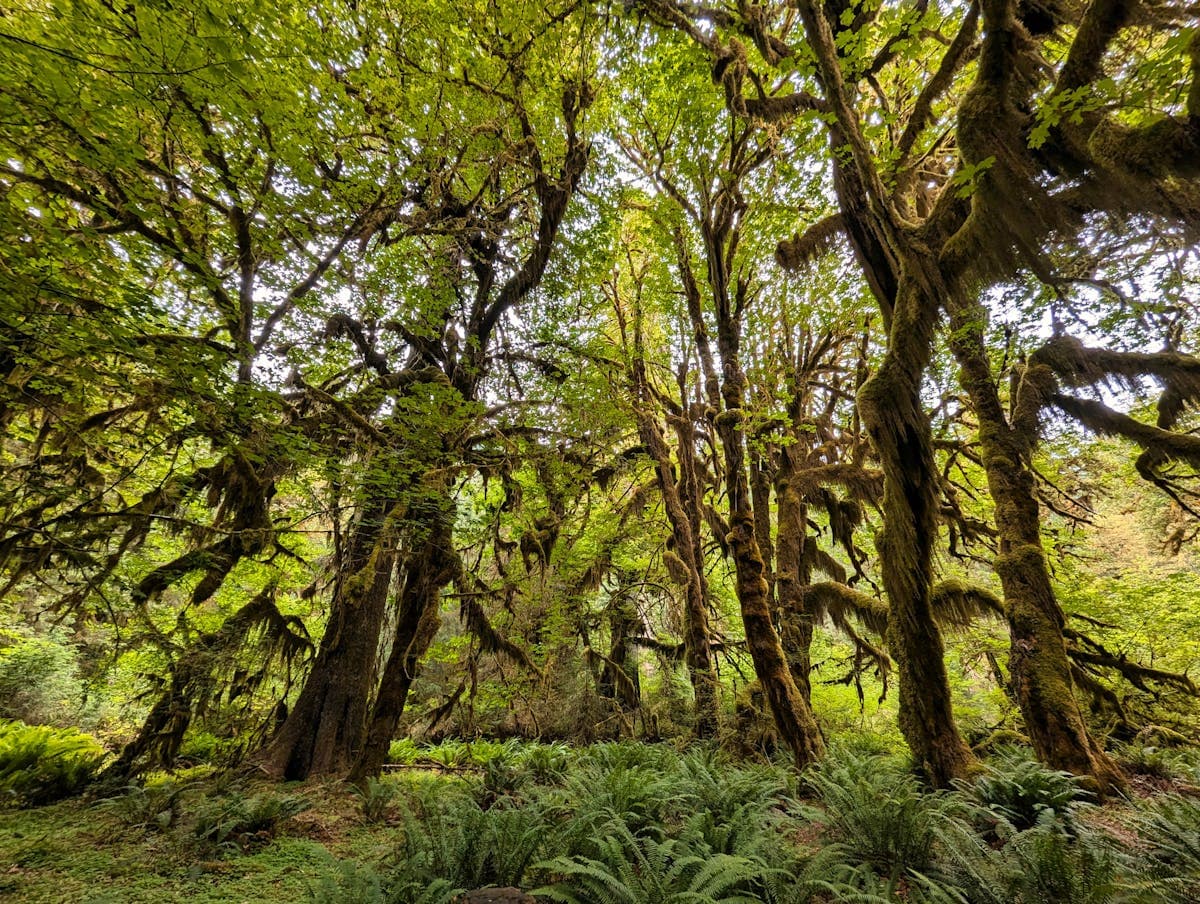
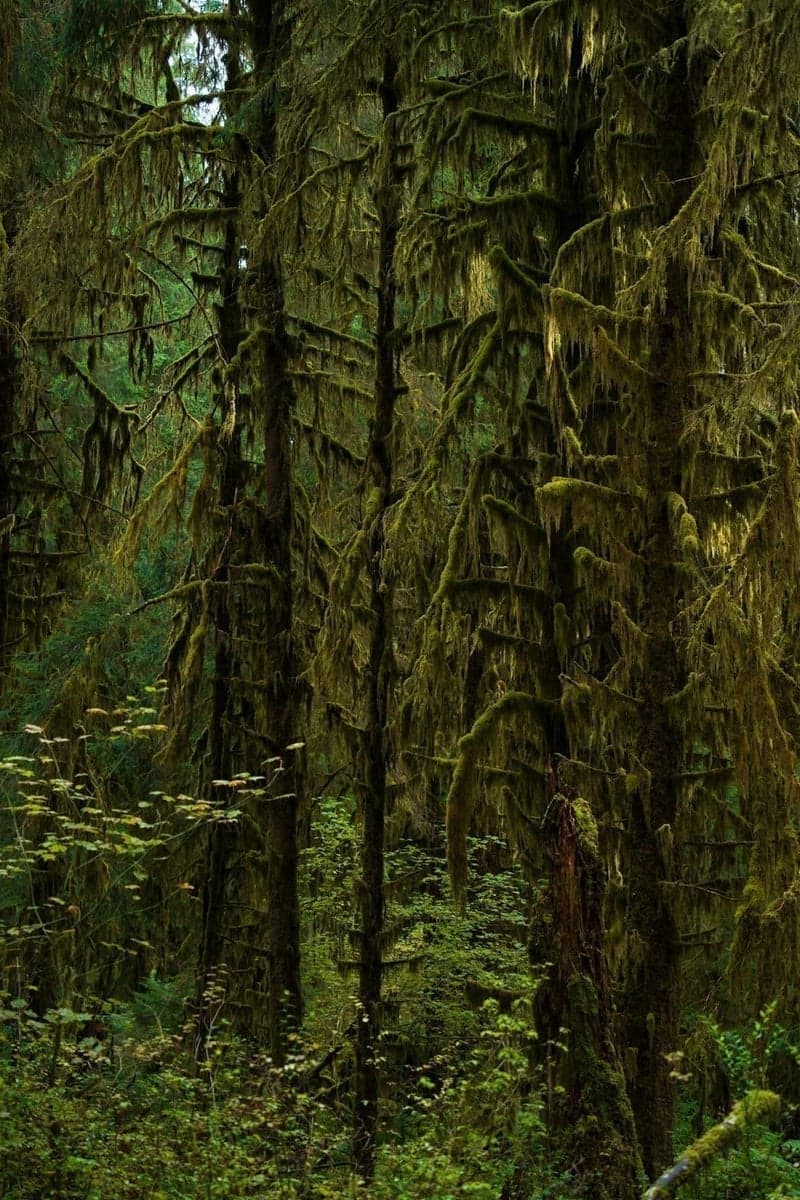
The Hoh Rain Forest canopy - Sitka spruce and western red cedar draped in moss create the cathedral-like atmosphere that defines this fishery
The trade-off: Limited access, wade-only fishing, and the park closure means a shorter season window. Most guided trips focus on the middle Hoh instead.
Middle Hoh (Morgan's Crossing to Oxbow)
This is the heart of Hoh River fly fishing -- the section where most guided drift boat trips operate. The middle Hoh offers roughly 8.5 river miles of classic steelhead water: long gravel bars, sweeping runs, deep pools behind logjams, and braided channels that create countless lies.
Key access points (upriver to downriver):
-
Morgan's Crossing: The primary put-in for drift boat trips. A gravel bar launch requiring 4WD, especially in wet conditions. No concrete ramp. Located off Hoh River Road approximately 12 miles from Highway 101.
-
DNR Campground (Minnie Peterson): Free camping with river access. Located between Morgan's Crossing and Oxbow on Hoh River Road. Good walk-and-wade water in either direction.
-
Oxbow Campground: The primary take-out for drift boat trips. Steep gravel ramp -- scout the approach before backing a trailer down. Free camping. Warning: The Oxbow itself (the tight river bend at the campground) contains technical whitewater that changes character with every major flood. First-time boaters should scout it at low water before running it.
Float logistics: The Morgan's Crossing to Oxbow float covers approximately 8.5 river miles and takes a full day (8-10 hours) when fishing thoroughly. No concrete ramps exist anywhere on the Hoh. All launches are gravel bars. 4WD is strongly recommended for all access points, and required at Morgan's Crossing.
What to look for in a run: The Hoh's classic steelhead water is 3-6 feet deep, moving at a steady walking pace, with a gravel or cobble bottom. Look for current seams where fast water meets slow, tailouts below pools, and the soft water behind and beside logjams. Steelhead hold where they can rest without fighting heavy current while remaining close to the main flow.
Named water: Guides do not typically publicize specific run names on the Hoh (unlike some rivers), but the best holding water concentrates around the major bends and gravel bar formations between Morgan's Crossing and Oxbow. The runs immediately below Morgan's Crossing see the heaviest pressure because every boat fishes them first. The middle third of the float -- roughly miles 3-6 below the put-in -- often holds more fish with less pressure. The water above Oxbow can stack fish that are resting before pushing upstream.
Why this section: The middle Hoh concentrates the best combination of holding water, fish numbers, and practical access. Drift boats allow you to cover miles of water, stopping to swing through productive runs. Most guided trips fish this section.
Lower Hoh (Oxbow to Tidewater)
The lower Hoh flows from Oxbow Campground to the river mouth near the Pacific, passing through the Hoh Indian Reservation at the very bottom. This section is wider, slower, and offers a different character than the middle river.
Key access points:
-
Cottonwood Campground: Free DNR campground with river access. Launch via Oil City Road. Good for drift boats accessing the lower river.
-
Willoughby Creek area: Where Willoughby Creek enters the Hoh, approximately 3 miles below Oxbow. Accessible from Oil City Road pulloffs. Fish stage here, particularly fresh arrivals moving upstream.
-
Nolan Creek Bar: Accessible from Highway 101. Bank fishing and informal launch for small boats.
Lower Hoh character: The river braids and widens significantly below Oxbow. Water is slower and deeper in spots, with more log debris. Fresh steelhead moving upriver from the ocean tend to hold briefly in the lower section before pushing into the middle and upper river, especially during rising water. On a dropping river, fish that arrived during the last storm spread out through the middle section, making the middle Hoh more productive.
Hoh Indian Reservation: The lowest section of the Hoh passes through the Hoh Indian Reservation. Tribal regulations apply. Contact the Hoh Tribe (360-374-6582) for current access rules and permits.
Spey Fishing and Swinging Flies
The Hoh River is one of the birthplaces of modern Pacific Northwest spey fishing. The wide gravel bars, long runs, and big water are tailor-made for two-handed rods and the classic swing.
Why Spey on the Hoh
Single-hand rods work, but a spey rod is the tool for this river. Here is why:
- Covering water: The Hoh's runs are 100-300 feet wide. A spey rod lets you cover that water efficiently, reaching lies that are simply out of single-hand range.
- All-day casting: Winter steelhead fishing means 8+ hours of repetitive casting. Two-handed rods distribute the workload and reduce fatigue.
- Obstructions: Brush and logjams often line the banks. Spey casts (snap-T, double spey, Perry poke) work where there is no room for a backcast.
- Sink tip control: Spey rods manage heavy sink tips and large intruder flies far more effectively than single-hand rods.
The Setup
Rod: 12'6" to 13'6" spey rod, 7-8 weight. A 13-foot 8-weight is the most versatile choice for the Hoh.
Line system: Skagit head is the workhorse for winter steelhead. Skagit lines handle heavy sink tips and large flies -- exactly what you need on the Hoh. Scandi heads work for lighter presentations in low, clear water.
Sink tips: Carry an assortment. The standard winter kit:
- T-11: Light current, shallow runs (3-4 feet deep)
- T-14: The all-purpose tip for most Hoh runs
- T-17 or T-18: Deep, fast runs where you need to get down quickly
Leader: 4-6 feet of 10-12 lb Maxima Ultragreen or fluorocarbon. Keep it simple. Steelhead are not leader shy in off-color water.
The Swing: Step by Step
- Wade to position: Stand at the top of the run, knee- to thigh-deep.
- Cast at 45 degrees downstream and across. On the Hoh, you are typically casting 60-80 feet.
- Mend upstream immediately after the cast lands. This slows the fly and lets it sink before the swing begins.
- Control the swing: The fly should sweep across the current at a steady pace. If it is racing, add more upstream mends. If it is stalling, throw a downstream mend.
- The hang down: When the fly reaches directly below you, hold it there for 5-10 seconds. Steelhead often follow and grab at the hang down.
- Step and repeat: Take two steps downstream (about 3-4 feet) and make the next cast. You are methodically covering every foot of holding water.
When a fish grabs: Do not set the hook. Let the fish turn and tighten the line against the rod. Then raise the rod firmly. A premature hook set on a swung fly pulls the fly away from the fish.
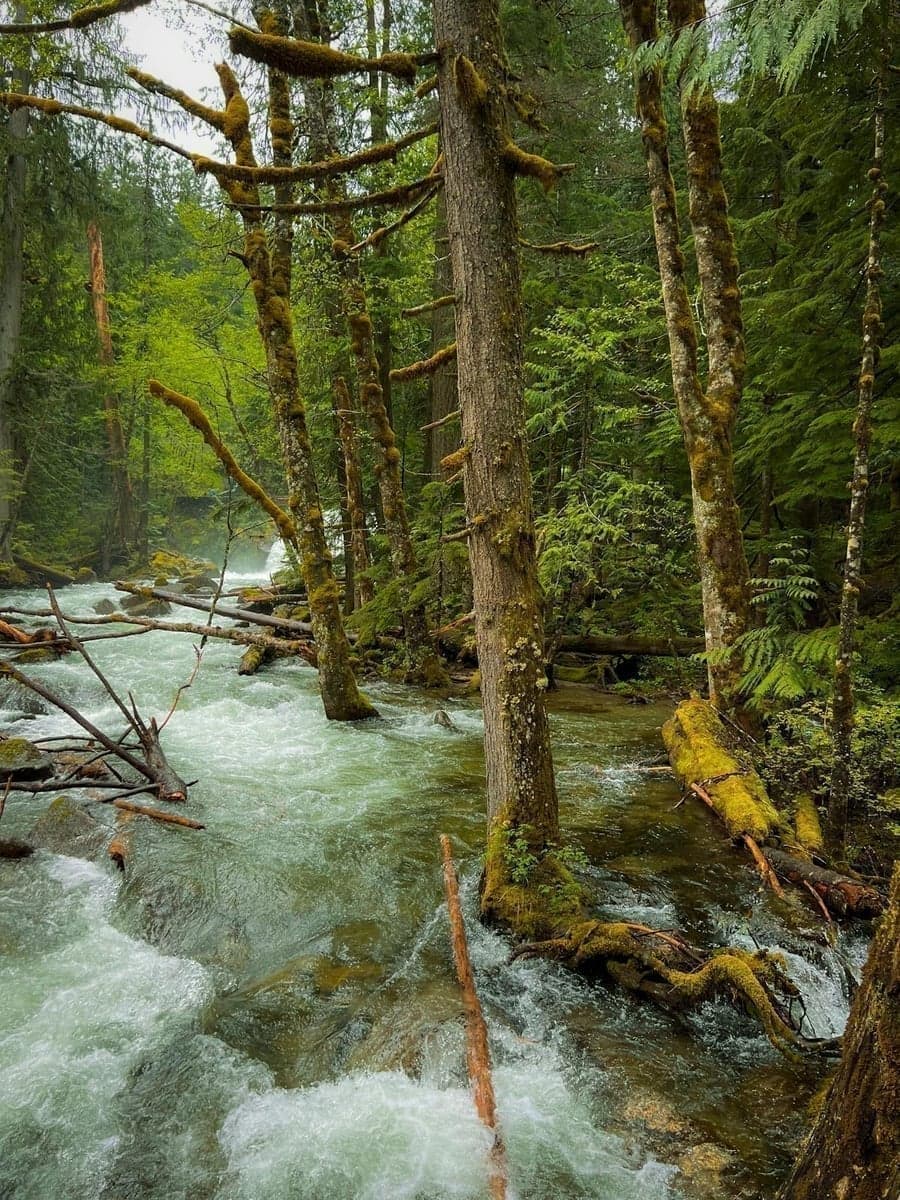
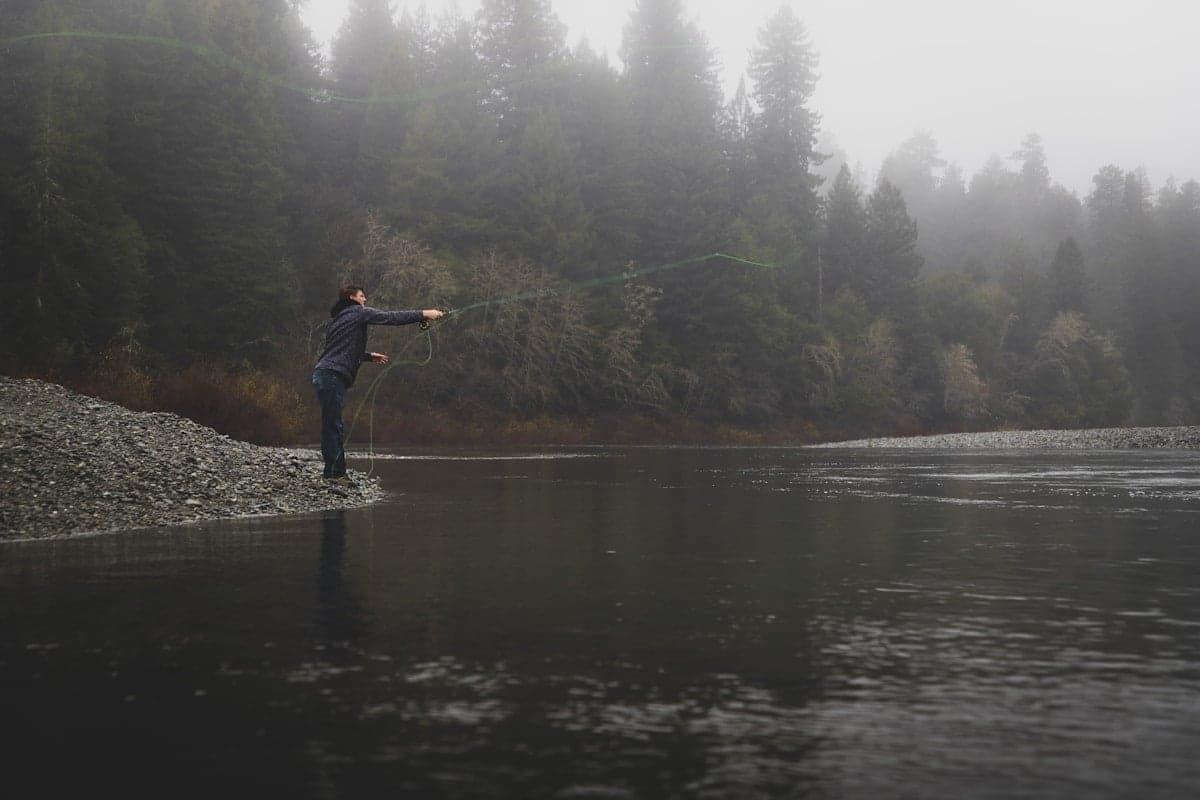
Fog rolls through the Hoh River valley - low-visibility mornings are common, but the river often clears as the day warms
Alternative: Indicator Nymphing
When water temperatures drop below 45 degrees or the river is high and off-color, many guides switch to indicator nymphing from the drift boat. This is not dry-fly-or-nothing water -- catching fish matters, and nymphing produces when swinging does not.
Nymphing setup:
- 9-foot 8-weight single-hand rod (or 11-foot switch rod)
- Large strike indicator (yarn or foam)
- Lead fly: Egg pattern, bead, or large stonefly nymph (#4-8)
- Dropper: Smaller egg pattern or Hoh Bo Spey variant, 18-24 inches behind
Many guided trips split time: 60-70% indicator nymphing from the boat through deeper runs, 30-40% getting out to swing flies through classic water. Do not be a snob about it. A day on the Hoh with no grab is a real possibility regardless of technique.
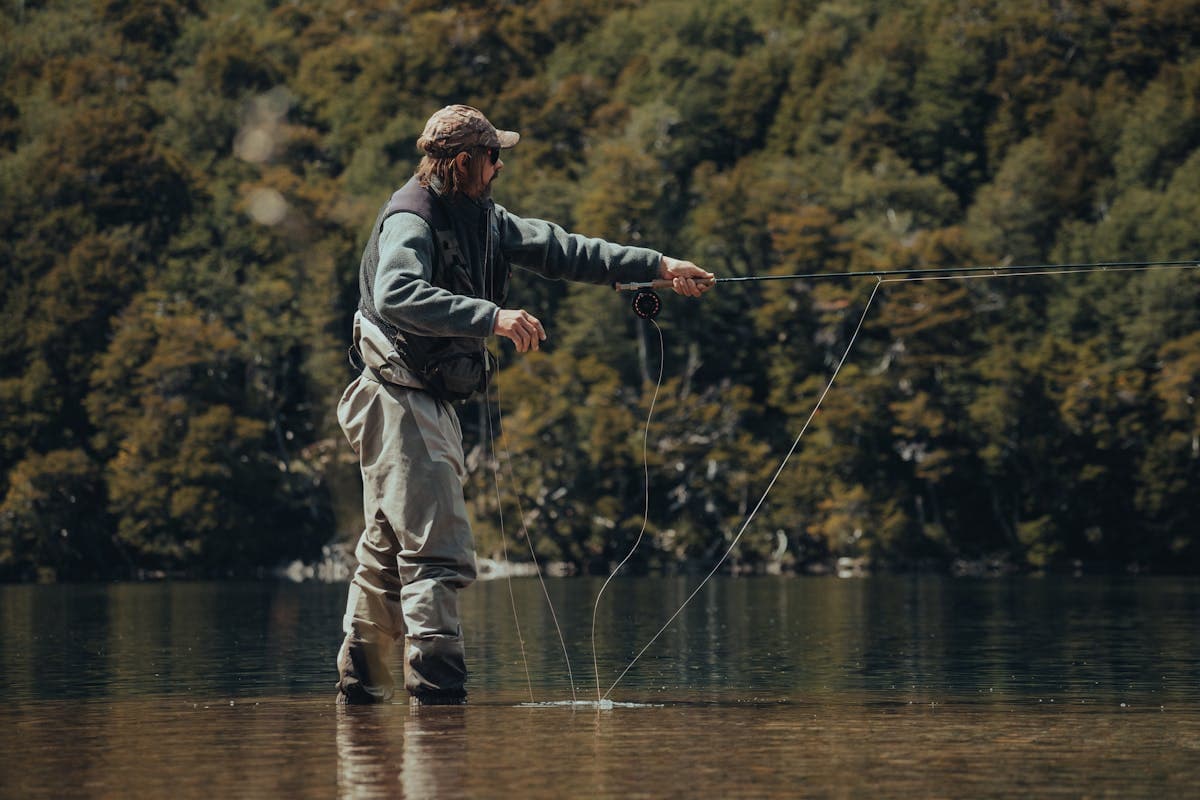
Winter steelhead fishing on the Hoh means long hours in cold, wet conditions. When a fish grabs, every miserable minute becomes worth it.
Fly Selection for the Hoh
Swinging Flies
- Hoh Bo Spey: The signature Hoh River pattern. Unweighted, versatile, works in all conditions. If you only bring one pattern, bring this in multiple colors.
- Intruders: Large, articulated flies that push water and trigger aggressive strikes. Black/blue for clear water, pink/orange for off-color.
- General Practitioner: Classic steelhead pattern. Orange, effective in moderate visibility.
- Mega Moal: Heavy, pushes water. Good in high, fast conditions.
- Skagit Minnows: Baitfish profile for aggressive fish.
- Tube flies: Increasingly popular. Detachable hook reduces leverage, improving hookup rates on big fish.
Nymphing Flies
- Glo Bugs / Egg patterns (#6-10, peach, pink, Oregon cheese): Year-round producers on the Hoh.
- Beads: Glass or plastic beads (8-10mm) pegged above the hook. Legal and effective.
- Stonefly nymphs (#4-8, black rubber legs): Fish them heavy, bouncing bottom.
- Hoh Bo Spey variants (weighted): The swing pattern adapted for dead-drifting.
Color Selection
| Water Clarity | Best Colors | Fly Size |
|---|
| Emerald green (ideal) | Black/blue, purple, natural tones | 2-3 inch profiles |
| Slightly off-color | Orange, pink, chartreuse | 3-4 inch profiles |
| High and murky | Hot pink, chartreuse, large dark silhouettes | 4+ inch profiles |
| Low and crystal clear | Black, sparse patterns, small profiles | 1.5-2 inch profiles |
When to Fish the Hoh
Season Overview
The Hoh River steelhead season runs December 1 through March 31. Within that window, timing matters enormously.
December: First hatchery steelhead arrive mid-month. River conditions are the most volatile -- December is the wettest month, and extended fishable windows are rare. Experienced anglers who can drop everything when conditions align do well. Planning a trip weeks in advance is a gamble.
January: Wild steelhead begin arriving in meaningful numbers. Conditions remain volatile but the ratio of fishable days improves. Water temperatures are cold (often below 42 degrees), which means fish are sluggish and nymphing outproduces swinging.
February: The sweet spot for many anglers. Wild steelhead numbers peak. Storm frequency begins to taper. Longer fishable windows between weather systems. Water temperatures climb into the mid-40s, making fish more responsive to swung flies. This is when the Hoh earns its reputation.
March: Late-season fishing can be outstanding. Fish are larger on average (late-run wild fish tend to be the biggest of the season). Weather is more stable. Pressure drops as some anglers move on. The season ends March 31 -- make the most of it.
Historical Run Timing
The Hoh steelhead run has shifted later over the past 70 years. In the 1950s, 25-50% of fish returned in November and December. Today, January is considered the start of the real wild steelhead season, with the peak in February and March. Plan accordingly.
Month-by-Month Hoh River Fishing Calendar
| Month | Fish Presence | Weather/Flows | Technique | Rating |
|---|
| Dec | Hatchery fish arrive mid-month; early wild fish | Wettest month; frequent blowouts; 38-40°F water | Nymphing dominant; limited swing windows | Fair -- high risk of unfishable conditions |
| Jan | Wild fish building; good numbers by late Jan | Still volatile; occasional dry spells; 38-42°F water | Nymphing 70%, swinging 30% | Good -- if you hit a weather window |
| Feb | Peak wild steelhead numbers | Storms tapering; more fishable days; 42-46°F water | Swinging becomes viable; 50/50 split | Excellent -- the prime month |
| Mar | Late-run wild fish; largest fish of season | Most stable weather; 46-50°F water | Best swing fishing; fish aggressive | Excellent -- don't miss March |
| Apr-Nov | Season closed | N/A | N/A | Closed |
Access Points: Detailed Guide
Getting to the Hoh
From Seattle: Drive west on US 101 to the town of Forks (approximately 3.5-4 hours). The Hoh River Road (Upper Hoh Road) turns south off Highway 101 about 13 miles south of Forks.
From Portland: Drive north on I-5, west on US 12, then north on US 101 to Forks (approximately 5-6 hours).
The town of Forks is your base of operations. It has grocery stores, gas stations, restaurants, a hospital, hardware stores, and outfitters. It is a full-service small town.
Access Point Details
| Access Point | River Mile (approx) | Type | 4WD Needed? | Notes |
|---|
| Hoh Rain Forest Campground | Upper river | Walk/wade, fly-only | No | Paved road to campground; park boundary fly-only section |
| Morgan's Crossing | ~mile 25 | Drift boat put-in | Yes | Gravel bar launch; primary put-in for guided floats |
| Minnie Peterson (DNR) | ~mile 21 | Camp + wade | Recommended | Free camping; river access; between Morgan's and Oxbow |
| Oxbow Campground (DNR) | ~mile 17 | Drift boat take-out + camp | Recommended | Steep gravel ramp; scout the Oxbow rapids first |
| Cottonwood Camp (DNR) | ~mile 12 | Camp + wade/boat | Recommended | Oil City Road access; lower river |
| Willoughby Creek | ~mile 14 | Wade/bank | No | Highway 101 access; fish stage here |
| Nolan Creek Bar | ~mile 8 | Bank/wade | No | Highway 101 pulloff; lower river |
Shuttle Services
For drift boat trips, you need shuttle service to move vehicles between put-in and take-out:
- Rainforest Paddlers: 866-457-8398 (located at Peak 16 Adventure Store, 6 miles up Hoh River Road)
- Ted Miller's Roadrunner Shuttle: 360-374-5195
- Don & Joann River Shuttle: 360-374-3161 or 360-640-9527
Book shuttles in advance during peak season (February-March). A typical shuttle for the Morgan's Crossing to Oxbow run costs $40-60.
Camping
All three DNR campgrounds on the Hoh (Minnie Peterson, Oxbow, Cottonwood) are free, first-come first-served, and open year-round. Maximum stay is 7 days per 30-day period. They have vault toilets but no water hookups. Bring your own water.
The Hoh Rain Forest Campground inside Olympic National Park has 78 sites ($20/night, first-come first-served in winter). Running water available in season.
Drift Boat vs. Walk-and-Wade
Drift Boat Advantages
The drift boat is the primary tool for fishing the Hoh effectively:
- Cover more water: The 8.5-mile Morgan's to Oxbow float gives you access to hundreds of runs, many inaccessible by foot.
- Anchor and swing: A good guide anchors above productive runs, letting you wade out and swing through them while the boat holds position.
- Nymph the deep water: Indicator nymphing from a slowly oared drift boat covers the deep pools and slots that wade anglers cannot reach.
- Manage high water: When the river is running 3,000-4,000 CFS, a drift boat keeps you safe and fishing while wade anglers are limited to a handful of spots.
Walk-and-Wade Advantages
Wade fishing the Hoh works, especially in the upper (park) section and from DNR campgrounds:
- No shuttle logistics: Park at a campground and fish upstream and downstream.
- Slower, more thorough coverage: You spend more time on each run.
- Upper Hoh access: The fly-only park section is wade-only.
- Less expensive: No guide or boat required.
Best walk-and-wade spots: Oxbow Campground has productive water both upstream and downstream. Minnie Peterson offers similar access. The fly-only section in Olympic National Park is the premier wade fishing option when conditions allow.
The Realistic Assessment
For a first trip to the Hoh, hire a guide with a drift boat. You will learn the river, understand where fish hold, see how conditions dictate strategy, and dramatically increase your chances of connecting with a fish. After a guided trip or two, you will have the knowledge to wade fish effectively on your own.
Olympic National Park Regulations
The Hoh River flows through Olympic National Park in its upper reaches, and park regulations add a layer of complexity.
Fly-fishing only: The section from Hoh Campground downstream to the park boundary is restricted to fly fishing only. No bait, no lures, no gear rods.
Barbless hooks: After December 14 each year, artificial lures with single-point barbless hooks are required within the park.
Park closure: The upper Hoh within Olympic National Park is closed through June 1 annually for wild steelhead spawning protection.
No license required for park waters: You do not need a Washington State fishing license to fish within Olympic National Park boundaries. However, a steelhead/salmon punch card is still required.
Below the park: Once you leave park boundaries (roughly at the Morgan's Crossing area), standard WDFW regulations apply. Washington State fishing license and steelhead punch card required.
WDFW Regulations (2025-26 Season)
Washington steelhead regulations are complex and have been tightening in response to declining wild steelhead populations.
Season: December 1 through March 31 on the Hoh River.
Daily limit: 2 hatchery steelhead (adipose fin clipped).
Wild steelhead: Must be released immediately. Cannot be fully removed from the water. Handle with wet hands, barbless hooks, and release quickly.
Selective gear rules: Single-point barbless hooks required. No bait or scents.
License requirements:
- Washington State Fishing License
- Steelhead/Salmon Punch Card
Emergency rules: WDFW issues emergency rule changes frequently in response to run size and conditions. Check the WDFW website before every trip. Sign up for their Fishing Rule Change email notifications.
Conservation: Wild Steelhead on the Hoh
The Hoh River's wild steelhead population is at a crossroads. NOAA's November 2024 assessment placed Olympic Peninsula steelhead at moderate extinction risk. Understanding the conservation picture is part of being a responsible angler on this river.
Hatchery vs. Wild
The Hoh receives both hatchery and wild steelhead:
- Hatchery fish: Identified by a clipped adipose fin (healed scar on the back near the tail). These fish can be retained (2 per day). Hatchery steelhead arrive earlier (mid-December) and are generally smaller than wild fish.
- Wild fish: Intact adipose fin. Must be released immediately and carefully. Wild Hoh steelhead are the genetic legacy of this river -- handle them with the respect they deserve.
Why It Matters
Wild steelhead populations across the Pacific Northwest have declined dramatically over the past 50 years. The Hoh still produces a meaningful wild run, but the numbers are a fraction of historical levels. WDFW's increasingly strict regulations -- shorter seasons, barbless hooks, selective gear rules, mandatory wild release -- reflect the urgency of the situation.
What You Can Do
- Release wild fish quickly and carefully: Barbless hooks, wet hands, keep the fish in the water, minimal handling.
- Report your catch: Use the WDFW catch card accurately. This data drives management decisions.
- Support conservation organizations: The Wild Steelhead Coalition and the Native Fish Society work specifically on Olympic Peninsula steelhead issues.
- Respect closures: The seasonal and area closures exist because they work. The upper Hoh closure through June 1 protects spawning fish during their most vulnerable period.
Hazards and Safety
Dense ferns and old-growth forest line the Hoh's banks - the valley receives 12-14 feet of rain annually, sustaining one of the last temperate rainforests on Earth
Logjams and Sweepers
The primary hazard on the Hoh River. Old-growth trees regularly topple into the river, and every major storm rearranges the wood. Logjams are deadly in moving water -- if you are swept into one, the force of the current pins you underwater.
For wade anglers: Never wade deeper than you are comfortable losing your footing. Keep your wading belt tight. A wading staff is essential on the Hoh's slippery cobble.
For drift boats: Scout unfamiliar sections. The Oxbow rapids change character with every flood. Logjams shift positions annually. If you are floating the Hoh for the first time without a guide, talk to the shuttle drivers -- they know where the wood is.
Flash Flooding
The Hoh can rise thousands of CFS in hours. If you are wading and notice the water rising or increasing turbidity, get out immediately. Do not wait.
Cold and Wet
December through March on the Hoh means rain, temperatures in the 30s-40s, and very little daylight. Hypothermia is a real risk.
Essential gear:
- Breathable chest waders with studded felt or rubber soles
- Multiple layers of wool or synthetic insulation (no cotton)
- Waterproof rain jacket and pants over your wading layers
- Fingerless wool or neoprene gloves
- Warm hat and neck gaiter
- Extra dry base layers in a dry bag
Remote Area
Cell service is nonexistent on most of the Hoh River Road and along the river. Tell someone your float plan. Carry a first aid kit. Fish with a partner when possible.
Emergency contacts:
- Forks Community Hospital: 360-374-6271
- Olympic National Park Emergency: 360-565-3000
- Clallam County Sheriff: 360-417-2459
Hiring a Guide
For first-timers on the Hoh, a guide is worth every penny. The river is big, conditions change constantly, and local knowledge -- which runs are fishing, where the wood has shifted, whether to swing or nymph -- makes an enormous difference.
What to Expect
A typical guided day on the Hoh:
- Meet at 7:00-7:30 AM in Forks or at the put-in
- Full day on the water (8-10 hours)
- Drift boat float from Morgan's Crossing to Oxbow
- Lunch on the river (provided by most guides)
- Mix of swinging and nymphing based on conditions
- All flies and terminal tackle provided
- Back to the take-out by 4:00-5:00 PM
Cost: $650-750 per day for 1-2 anglers. Tips are customary (15-20% for a good day).
Guide Services
Waters West Fly Fishing Outfitters (Port Angeles)
- 140 W Front Street, Port Angeles
- Olympic Peninsula's premier fly shop since 1998
- Full-day guided trips: $695 (+$100 for 3rd angler)
- Spey specialists
- waterswest.com
Emerald Water Anglers
- Swing-only guide service (no nymphing)
- Full day: $695
- Includes lunch, beverages, flies, equipment
- emeraldwateranglers.com
Anadromy Fly Fishing (Forks)
Blue Heron Guide Service (Larry Ford - Forks)
Book early: February and March dates fill months in advance. If you want a specific guide during peak season, book by November.
Gear Checklist
Rods and Reels
| Setup | Specs | Use |
|---|
| Primary spey rod | 12'6"-13'6", 7-8 wt | Swinging flies -- the main tool |
| Switch rod (optional) | 11', 6-7 wt | Lighter swinging, tight quarters |
| Nymphing rod (optional) | 9'-10', 7-8 wt single-hand | Indicator nymphing from the boat |
| Reel | Large arbor, sealed drag, 150+ yds backing | Must handle 15+ lb fish in current |
Line System
- Skagit head: 450-600 grain (matched to rod weight). The workhorse line for the Hoh.
- Sink tips: T-11, T-14, T-17 in 10-15 foot lengths
- Floating tip: For shallow runs and low water
- Running line: 30-40 lb slick shooting line
- Leader: 4-6 feet of 10-12 lb Maxima Ultragreen or fluorocarbon
Terminal Tackle
- Intruders and tube flies in assorted colors (6-10 patterns minimum)
- Egg patterns (#6-10)
- Beads (8-10mm, peach/pink)
- Split shot (size BB and larger)
- Strike indicators (yarn or foam, if nymphing)
- Forceps/hemostats for barbless hook removal
Clothing and Safety
- Chest waders (breathable) with studded boots
- Wading belt (cinched tight -- non-negotiable)
- Rain jacket and pants (Gore-Tex or similar)
- Wool or fleece layers (multiple)
- Fingerless gloves
- Warm hat, neck gaiter
- Polarized sunglasses
- Wading staff
- Large rubber-mesh net (20"+ bag)
Common Mistakes on the Hoh
-
Not checking flows before driving: The Hoh can be perfect or unfishable. A 4-hour drive to a blown-out river is avoidable. Check RiverReports before you leave.
-
Fishing when the river is too high: 4,000+ CFS is not safe for wading and barely productive from a boat. Patience pays.
-
Swinging when you should be nymphing: Water below 45 degrees and off-color conditions call for nymphing. Pride catches fewer fish than adaptability.
-
Ignoring the hang down: Many grabs come after the swing, when the fly holds directly downstream. Count to ten before picking up and recasting.
-
Oversetting the hook: On a swung fly, let the fish turn before raising the rod. A premature set pulls the fly away.
-
Inadequate rain gear: You will get wet. Cotton kills. Bring more dry layers than you think you need.
-
Skipping the shuttle call: During peak season, shuttle drivers book up. Arrange your shuttle the day before.
-
Underestimating drive time: Forks is 4 hours from Seattle in good conditions. In winter storms, add an hour.
First-Timer's Recommendation
If this is your first trip to the Hoh River, here is where to start:
When: Target the last two weeks of February or the first two weeks of March. Wild steelhead numbers are peaking, weather is more stable than December-January, and water temperatures are climbing into the range where fish respond to swung flies.
How: Book a guide. A full-day drift from Morgan's Crossing to Oxbow with an experienced Hoh River guide will teach you more in one day than a week of self-guided fishing. Budget $650-750.
Gear: If you do not own a spey rod, your guide will provide one. If you want to bring your own, a 13-foot 8-weight with a Skagit head is the most versatile setup.
Duration: Plan for 3-4 days minimum. You will likely lose at least one day to weather or high water. Having flexibility in your schedule is the single biggest predictor of success on the Hoh.
Expectations: You might not catch a fish. Many experienced steelhead anglers spend multiple days between hookups on the Hoh. The fish-per-day average on a good week might be 0.5. But when a 12-pound wild winter steelhead grabs your swung Intruder in three feet of emerald water, it will redefine your understanding of what fly fishing can be.
Sample 4-Day Trip Itinerary
Day 0 (Travel Day): Drive from Seattle to Forks (4 hours). Check into lodging. Stop at the hardware store or local outfitter to buy a WA fishing license and steelhead punch card if you do not have them. Check the Hoh River flow gauge and weather forecast. Call your shuttle service to confirm tomorrow's logistics. Early dinner, early bed.
Day 1 (Guided Day): Meet your guide at 7:00 AM. Full-day drift from Morgan's Crossing to Oxbow. Learn the river -- pay attention to which runs your guide targets, how they read water color and speed, and when they switch from swinging to nymphing. This is your education day. Back by 5 PM. Debrief over dinner in Forks.
Day 2 (Self-Guided Wade): Based on what you learned yesterday, drive to Oxbow or Minnie Peterson campground. Wade fish upstream and downstream through the runs you identified from the boat. Spend 30-45 minutes per run, methodically stepping through. If the Hoh is blown out, drive to the Sol Duc (it clears faster) or explore the Bogachiel.
Day 3 (Flex Day): If conditions are good, repeat Day 2 at a different access point. If the Hoh is high, consider the upper fly-only section in the park (if open) or book a second guided day on whichever river is fishing best. This flex day is why you planned 4 days -- weather dictates the agenda.
For a broader look at all the rivers in the area, see our Olympic Peninsula fly fishing guide, which covers the Sol Duc, Bogachiel, Calawah, Quillayute, and Lake Crescent.
Hoh River Fishing Report: How to Stay Current
Unlike tailwater fisheries with predictable flows, the Hoh River changes daily. A Hoh River fishing report from last week is almost useless for planning this week's trip. Here is how to stay on top of current conditions:
Real-time flow data: Check Hoh River flows on RiverReports for the USGS 12041200 gauge updated every 15 minutes. This is your primary planning tool.
Weather forecasts: The NOAA forecast for the Hoh River drainage (Forks, WA area) drives everything. Watch for 48-72 hour dry windows following rain events.
Guide reports: Follow local guide services on social media for on-the-water reports. Waters West, Emerald Water Anglers, and Anadromy all post fishing reports during season.
WDFW emergency rules: Regulations can change mid-season. Sign up for WDFW Fishing Rule Change email notifications and check the WDFW website before every trip.
Shuttle drivers: Call the shuttle services listed above. They are on the river daily and know current conditions, wood hazards, and where fish are being caught. A two-minute phone call can save you a wasted day.
Using RiverReports
Before your trip, check:
- Washington river flows for real-time Hoh River CFS data
- Historical flow comparisons to understand whether current conditions are high, low, or normal for the time of year
- Weather forecasts -- timing trips around storm cycles is everything on the Hoh
The Hoh's USGS gauge (12041200) updates every 15 minutes. During storm season, check it multiple times per day. When you see the river drop below 2,500 CFS after a storm, start driving.
Frequently Asked Questions
What is the best time to fish the Hoh River for steelhead?
February and March are the best months for Hoh River steelhead fishing. Wild steelhead numbers peak during these months, weather is more stable than December or January, and water temperatures climb into the 42-50 degree range where fish are most responsive to swung flies. Late March fish tend to be the largest of the season. If you can only pick one week, target the last week of February or the first week of March.
What is the ideal flow for fishing the Hoh River?
The ideal Hoh River flow for fly fishing is between 1,500 and 2,500 CFS at the USGS 12041200 gauge (Highway 101 bridge). At these levels, the water takes on its signature emerald green color with 2-4 feet of visibility -- perfect for swinging flies. The river is fishable up to about 4,000 CFS for experienced anglers, but conditions are challenging above 3,000 CFS. Below 1,000 CFS, fish become spooky and require lighter presentations.
Do I need a spey rod to fish the Hoh?
You do not need a spey rod, but it is strongly recommended. The Hoh's wide runs (100-300 feet) are most efficiently covered with a two-handed rod, and the all-day casting required for steelhead is far less fatiguing with spey equipment. A 13-foot 8-weight spey rod with a Skagit head is the standard setup. If you hire a guide, they will provide a spey rod for you.
How much does a guided trip on the Hoh River cost?
A full-day guided drift boat trip on the Hoh River runs $650-750 for 1-2 anglers. This typically includes the boat, all terminal tackle and flies, lunch, and 8-10 hours on the water. Tips of 15-20% are customary. Book February and March dates by November, as prime season fills fast.
Can I wade fish the Hoh without a guide?
Yes. The DNR campgrounds (Oxbow, Minnie Peterson, Cottonwood) provide free river access with productive wade fishing upstream and downstream. The fly-fishing-only section inside Olympic National Park is also wade-only. However, a drift boat covers far more water and is the most effective way to fish the middle Hoh. For a first trip, a guided day is worth the investment to learn the river.
Is the Hoh River open year round?
No. The Hoh River steelhead season runs December 1 through March 31. The upper Hoh within Olympic National Park is additionally closed through June 1 for wild steelhead spawning protection. Always check WDFW for current season dates and emergency rule changes.
What is the difference between hatchery and wild steelhead on the Hoh?
Hatchery steelhead have a clipped adipose fin (the small fin on the back near the tail is missing or scarred). You can keep up to 2 hatchery fish per day. Wild steelhead have an intact adipose fin and must be released immediately -- they cannot be fully removed from the water. Wild fish are the genetic backbone of the Hoh's steelhead population and their protection is critical for the river's future.
How do I get to the Hoh River from Seattle?
Drive west on US 101 to the town of Forks, approximately 3.5-4 hours in good conditions. The Hoh River Road turns south off Highway 101 about 13 miles south of Forks. In winter storm conditions, allow extra time -- the road can be slow. Forks is the nearest town with full services (gas, groceries, lodging).
What flies work best on the Hoh River?
The Hoh Bo Spey is the signature pattern for swinging. Intruders in black/blue (clear water) and pink/orange (off-color water) are also essential. For nymphing, egg patterns (Glo Bugs, beads in 8-10mm, peach/pink) and weighted stonefly nymphs are the workhorses. Carry a range of sizes and colors to match changing water clarity.
Quick Reference: Hoh River at a Glance
| Category | Details |
|---|
| Location | Olympic Peninsula, WA (south of Forks) |
| Species | Winter steelhead (wild + hatchery) |
| Season | December 1 - March 31 |
| Peak fishing | February - March (wild steelhead) |
| USGS Gauge | 12041200 (Hoh River at US Hwy 101) |
| Ideal flow | 1,500-2,500 CFS (emerald green water) |
| Fishable range | Up to ~4,000 CFS |
| Average fish | 10-12 lbs |
| Trophy potential | 20+ lbs every season |
| Primary technique | Spey rod, swung flies |
| Best float | Morgan's Crossing to Oxbow (~8.5 miles) |
| Guide cost | $650-750/day for 1-2 anglers |
| Nearest town | Forks, WA |
| Drive from Seattle | ~4 hours |