
Trout Redds: How to Spot Them and Fish the Fall Spawn Right
Fishing during the spawn is fine. Standing in the gravel is not.
Greg Lamp
August 27, 2026
9 min read
Fishing during the spawn is fine. Standing in the gravel is not. That distinction gets lost every October, and usually not because anglers are careless. It's because most of us were never taught what a redd looks like, so we walk across them without ever knowing they were there.
That's a fixable problem. Redds have a specific shape, they show up in specific water, and once you've seen a few you stop being able to walk past them. Here's how to read them, when to expect them, and why the flow chart you check in January decides whether this fall's eggs ever become fish.
What a redd actually looks like
A redd is a gravel nest. The female turns on her side and beats her tail against the bed, blasting silt and algae out of the cobble and cutting a shallow pit. She drops eggs in the pit, a male fertilizes them, and she covers them with gravel kicked in from just upstream.
That process leaves two features you can see from the bank. There's a pit, a scooped-out depression at the upstream end, and a tailspill, a raised mound of loose gravel piled at the downstream end. Trout Unlimited's redd survey handbook calls that combination a "classic pit and tailspill," and notes that a complete redd is generally a foot long or more, oblong, running parallel to the current.
The color is the giveaway. All that tail-beating strips the algae and fine sediment off the rocks, so a fresh redd sits on the bottom as a bright, clean oval against a darker, siltier streambed. It reads like someone scrubbed a two-foot patch of river. Arkansas Game and Fish describes them as clean, oval patches of small to medium gravel roughly two to three feet across.
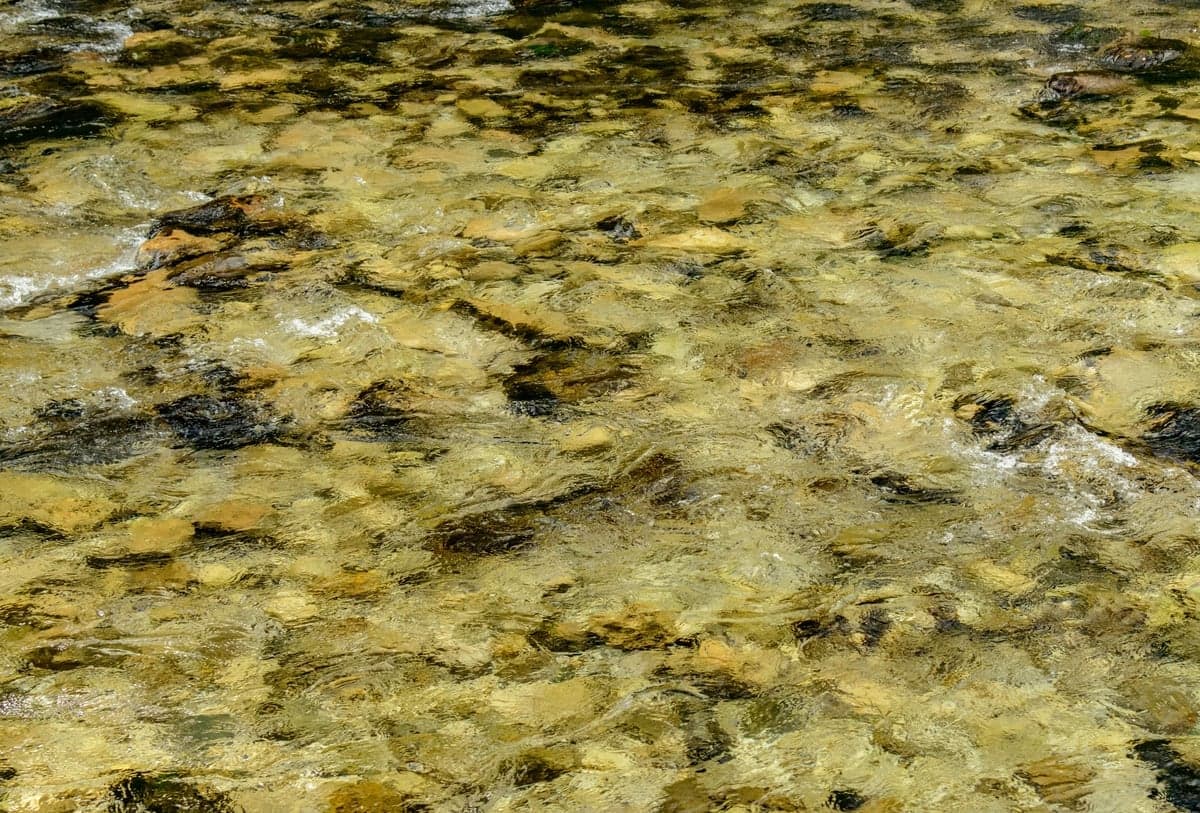
Clean, sorted gravel in shallow, moving water. This is the bottom type worth slowing down for in October and November.
Where to look for them
Trout don't build redds just anywhere. They want gravel small enough to move with a tail and big enough to hold together, plus current strong enough to push oxygenated water down through the nest.
That combination shows up in two places. The first is the tailout of a pool, where the flat water starts to shallow up and accelerate before it breaks into the next riffle. The second is the head of a riffle, right where the water speeds up over the shelf.
Both are exactly the spots most of us step through without thinking, on the way to somewhere better.
Wear polarized glasses and actually look at the bottom before you commit a boot. If you see a bright patch of clean gravel in shin-deep water, walk the bank around it. The bright color fades over days to weeks as algae recolonizes the rocks, so a redd stays visible long after the fish that built it have moved on.
Who spawns when
This is where a lot of anglers get it backwards. Fall spawners are brown trout and brook trout. Rainbows and cutthroat spawn in the spring, generally March through June, which means those bright gravel patches you find in April belong to a different fish entirely.
Brown trout spawn from September into December depending on where you are, with October and November doing most of the work. Michigan DNR notes browns spawn in tributary streams in September and October. Montana FWP records browns in the Beaverhead starting in late October. Brook trout run a similar calendar, generally October and November, often a couple weeks ahead of the browns in the same drainage.
Two things pull the trigger: shortening daylight and dropping water temperature. Browns start staging toward gravel as water slides into the mid-40s and low 50s, and the digging picks up once the river settles into the 40s.
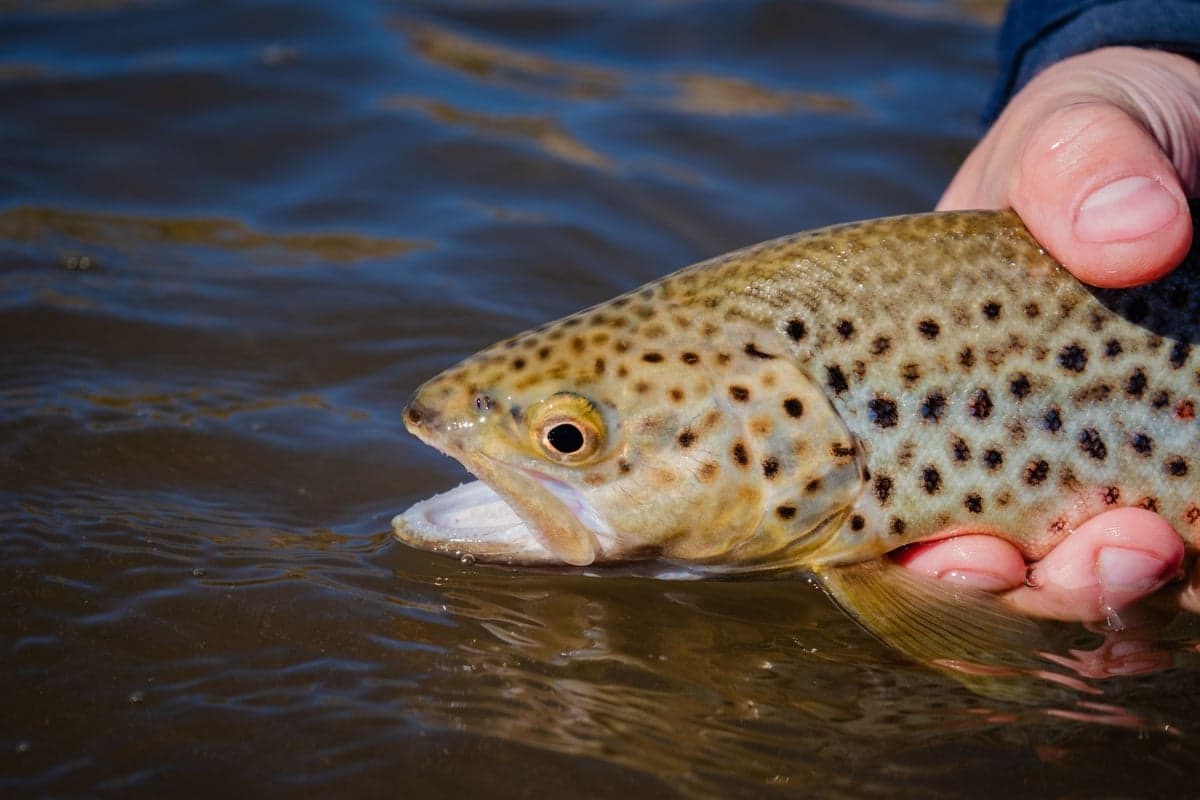
A wild brown going back into the river. Browns do most of the digging from October into December, and the big males color up hard and grow a pronounced hooked jaw before they get there.
Elevation and latitude move the whole schedule. A high Colorado freestone can be done spawning by early November while a lower valley river is just getting started. Tailwaters are their own case, because a dam releasing 45-degree water year-round doesn't hand fish the same seasonal temperature cue a freestone does. Spawning below dams often runs later and longer than the calendar suggests.
Why one bad step matters
The eggs don't hatch and swim away. They sit in the gravel through the winter, and how long depends almost entirely on water temperature. Iowa DNR's brown trout profile gives the general case: eggs incubate through the winter, hatch in late winter, and the fry emerge from the gravel on the first warm days of spring. Colder water stretches that out. Montana FWP puts it plainly for the Beaverhead: browns start spawning in late October, and the eggs are in the gravel and vulnerable to trampling until the third Saturday in May.
For most of that stretch, a boot in the wrong place is fatal to whatever's under it. The best measurement we have comes from Roberts and White's 1992 study in the North American Journal of Fisheries Management, which buried eggs in artificial redds and walked on them. Twice-daily wading through incubation killed up to 96% of eggs and pre-emergent fry. A single pass just before hatching killed up to 43%.
The twice-daily treatment is a lab extreme, not a fishing trip. The single-pass number is the one worth carrying around, because that's a thing an angler does on a normal afternoon without a second thought. Eggs are toughest right after fertilization and most fragile in the weeks before emergence, which is late winter and early spring on most rivers. The damage window is longer than the spawn.
The part nobody watches: winter flows
Here's the angle that gets almost no attention. Those eggs sit in the gravel from October through spring, which means the flow regime between fall and runoff decides how many of them survive. Not the hatch, not the pressure. The winter hydrograph.
Two things go wrong. If flows drop hard, redds built at higher water end up in the margins or fully out of the river. A 2010 University of Montana study of brown trout egg survival found the pattern directly: the lower the water level, the colder the temperature inside the redd, and the colder the redd, the more eggs died. Going dry is the obvious failure. Going cold and shallow is the quiet one.
The other direction is a scouring flush. A big enough release or rain event mobilizes the bed and moves the gravel, and the eggs go with it.
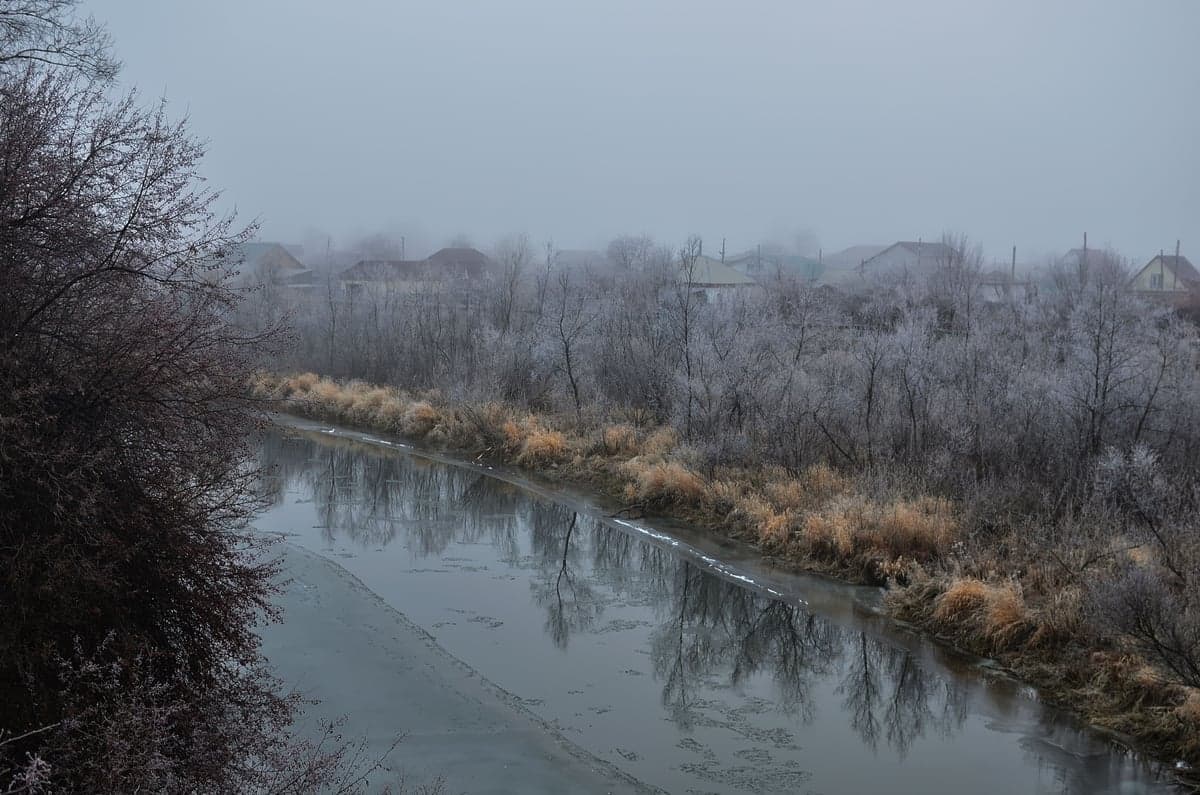
January on a tailwater. The eggs from October are still in the gravel, and what the dam does now decides how many make it.
Montana's Beaverhead is the cleanest example anywhere. FWP's own drainage plan reports that overwinter releases from Clark Canyon typically drop from 600 to 800 cfs during irrigation season to as low as 25 cfs around October 1, right as browns start spawning. Over the past 20 years, overwinter releases hit 200 cfs or better in only 2 years and were 50 cfs or less in 15. FWP research says 100 cfs overwinter is what the tailwater fishery actually needs. The eight miles below the dam hold 200 to 500 redds per mile, so those numbers aren't abstract.
You can watch this yourself. Pull up Montana flows in December and see where the Beaverhead, Madison, and Missouri are sitting compared to October. Same for Colorado flows on the South Platte and the Fryingpan. If a tailwater fell off a cliff after the irrigation season ended, that's the year class taking the hit.
How to fish October and November anyway
None of this means stay home. Fall is one of the best stretches of the year, and most of it is completely clean.
Fish the runs, pools, and deep buckets, not the shallow gravel tails. Pre-spawn and post-spawn browns are aggressive and eating, and a streamer swung through a deep run in November is about as good as trout fishing gets. Those fish are fair game.
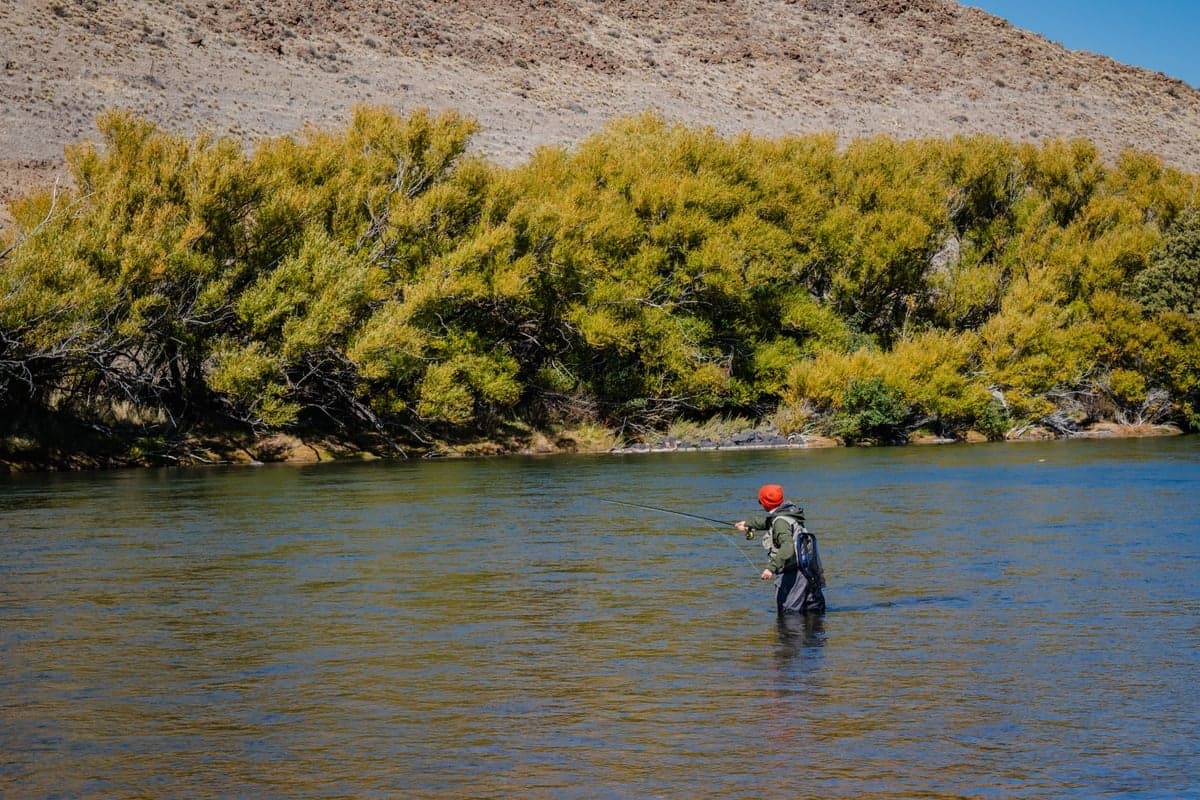
Work the deep water and stay off the shallow gravel. It's not much of a sacrifice, and the fish in the runs are eating better anyway.
Don't target fish sitting on a redd. A paired-up male and female parked over bright gravel in six inches of water are not there to eat, and dragging them off the nest leaves the eggs exposed to whatever's sitting downstream waiting for exactly that. If you can see the fish that clearly, keep walking.
Walk the bank around bright gravel, and cross at deep, dark, silty water instead of shallow clean water. Counterintuitive but correct: the ugly bottom is the safe bottom.
This comes up most on the Madison and Missouri in Montana, the South Platte and Fryingpan in Colorado, Michigan's Au Sable, and the Great Lakes tributaries, where fall-run browns are on the gravel while everyone is chasing steelhead through the same runs.
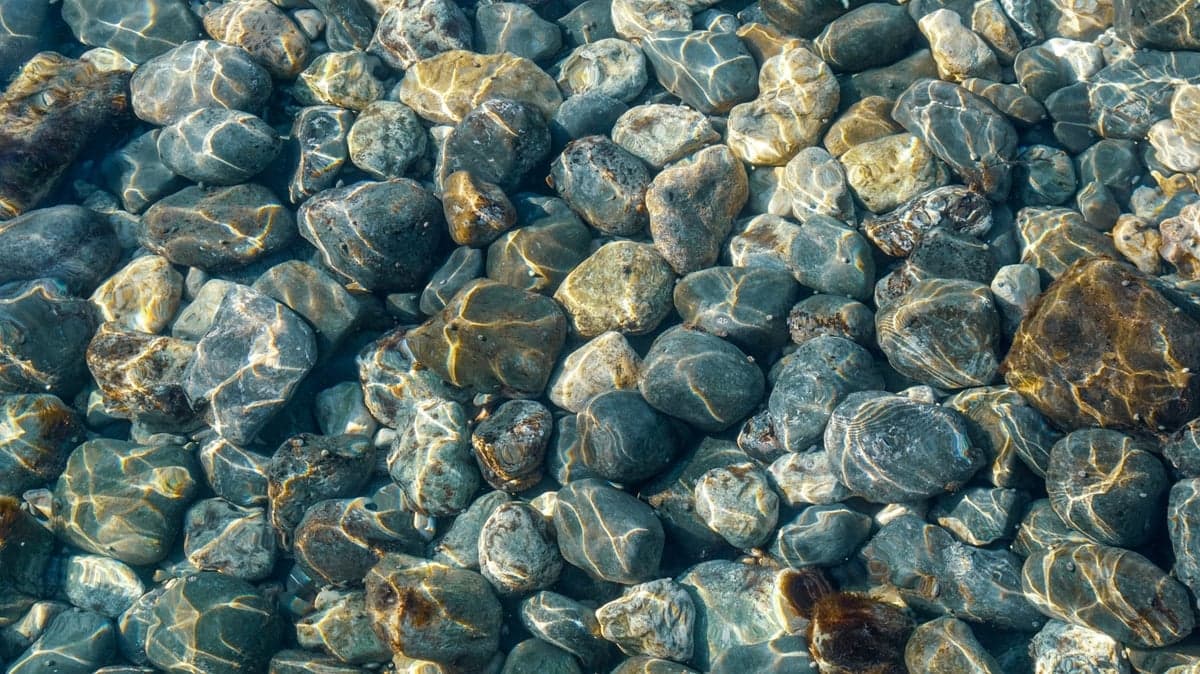
Clean, bright, sorted gravel in shallow water. If it looks scrubbed compared to everything around it, go around.
Check the regs before you go
Plenty of states close specific waters during the spawn, and the rules change. Montana FWP has closed reaches to protect spawning trout, and its Beaverhead plan recommends closing Clark Canyon Dam down to Pipe Organ Bridge from October 1 to the third Saturday in May. Colorado Parks and Wildlife runs seasonal closures on known spawning stretches. Arkansas closes a section below Bull Shoals every winter.
Look up your water on the state agency's current regulations page before the trip. Montana FWP posts its rules and in-season restrictions in one place, and every other state has an equivalent. A closure you didn't know about is still a violation.
The short version
Look for bright, clean, oval gravel in shallow water at pool tails and riffle heads. Assume it's occupied from October through spring. Walk around it, fish the deep water, and leave paired fish alone.
Then check the flows in January. Pull up your home river on the Colorado or Montana flow pages, or whichever state you fish, and look at what the winter hydrograph is doing. The eggs are still down there, and they're still counting on it.
Get River Intel Weekly
Flow updates and fishing intel delivered every Thursday.
River Intel Weekly
Weekly flow updates and fishing intel.
© 2026 RiverReports, Inc.